
For a B2B SME, TOFU content (top of the funnel) answers your future customers' problems without talking about your offer, MOFU content (middle) helps them compare solutions, and BOFU content (bottom) removes the last obstacles before signing. In practice: educational articles and posts for TOFU, guides, comparisons and case studies for MOFU, demos, client references and answers to objections for BOFU.
The framework is simple. Applying it is less so. In an SME with 10 to 50 employees, it is rare for anyone to be paid full time to write, the sales cycle is counted in weeks, and several people weigh in before a purchase order goes out. The risk is twofold: publishing at random, or publishing nothing but promotion. This article shows what to produce at each stage, using the fictitious but realistic example of a 30-employee conveyor manufacturer, then how to split the effort and measure what each piece of content brings in.
What do TOFU, MOFU and BOFU mean in B2B marketing?
The three acronyms stand for Top of the Funnel, Middle of the Funnel and Bottom of the Funnel. They split the buyer journey into three moments, from the first sign of a problem to the decision. Each moment matches a different question in the buyer's mind.
At the TOFU stage, the buyer has a symptom: a packaging line running at full capacity, picking errors, a team chasing follow-ups. They are not looking for a supplier yet. At the MOFU stage, they have named their problem and are comparing ways to solve it. At the BOFU stage, they have a shortlist of two or three suppliers and are looking for a reason to choose one over the other.
Content that answers a question from another stage falls flat. A price list sent to someone who is just discovering their problem scares them off. An introductory article sent to a buyer who is ready to sign wastes their time.
| Stage | Buyer's question | Suitable formats | Call to action |
|---|---|---|---|
| TOFU, discovery | “Why do I have this problem?” | Blog article, LinkedIn post, short video, infographic | Read more, subscribe |
| MOFU, evaluation | “What solutions are out there?” | Downloadable guide, comparison, case study, webinar, checklist | Download, sign up |
| BOFU, decision | “Why you?” | Demo, detailed client references, sales FAQ, simulator | Request a quote or a call |
In B2B, buyers often do their research on their own, on your website and your competitors', before getting in touch. Your content therefore does part of the sales work before the first meeting, provided it sits at the right point in the journey.
What content should you publish at the top of the funnel (TOFU)?
TOFU content answers a question your customer asks before they know they need you. It doesn't talk about your product. It talks about their problem, in their own words.
For our conveyor manufacturer, this could be, for example:
- an article “5 signs a packaging line is reaching full capacity”;
- a LinkedIn post on the time lost at every format changeover on a line;
- a two-minute video showing a common handling mistake and its cause;
- an infographic on the points to check before expanding a workshop.
A good TOFU topic comes from a question your salespeople hear often. A bad one comes from a brainstorm with no customer in the room. A simple test: if the question can be typed as is into Google or an AI, the topic holds up.
The call to action stays light. Nobody requests a quote after a discovery article. You suggest reading a related piece, subscribing to a newsletter, or downloading a guide that moves the reader to the next stage. That step is what turns an audience into contacts.
Don't judge TOFU content by the number of quote requests it generates: that's not what it's for. Judge it by the quality of the audience it attracts, the right people in the right companies.

You when your discovery article got 2,000 views and you've been watching for a quote request for three days.
What content for the middle of the funnel (MOFU)?
At the MOFU stage, the buyer has put a name to their problem. They are looking for the options, their pros, their limits, their approximate cost. For a B2B SME, this is a decisive stage: it is where the shortlist of suppliers to consult takes shape.
The formats that work are the ones that help people decide:
- a downloadable guide, for example “Choosing the right conveyor: belt, roller or chain”;
- an honest comparison of solutions, including the ones you don't sell;
- a case study that tells the story of a problem, the chosen solution and the result;
- a 30-minute webinar with live Q&A;
- a checklist to fill in before launching a request for proposals.
MOFU content is the content people exchange for an email address. Readers agree to leave their details because the guide saves them time on a real decision. If the guide is a catalog in disguise, they won't come back.
Another B2B specificity: MOFU content gets passed around. The production manager who downloaded the guide may forward it to the CFO and the CEO. Write it so that it stands on its own without you, with the selection criteria and the questions to ask any supplier.
What content for the bottom of the funnel (BOFU)?
At the BOFU stage, the buyer has two or three suppliers in mind. They are no longer asking what to buy, but who to buy from. The content must prove, reassure and make the decision easier.
- detailed client references: the customer's industry, the starting problem, the solution, the result;
- a demo or a visit, on video or on site;
- a sales FAQ that answers known objections: lead times, installation, maintenance, warranty;
- a simulator or a grid that helps estimate a budget;
- testimonials from customers who resemble the prospect.
This content doesn't necessarily get published on LinkedIn. Much of it serves the sales team first, who send it at the right time, after a first conversation. A case study sent the day after a meeting answers a specific question; the same case study posted in the middle of the news feed often goes unnoticed.
At the bottom of the funnel, content hands over to the sales conversation, and the way you present your offer in a few minutes matters as much as the documents you send. We have devoted a guide to this exact moment, with a six-step framework, 30-second, 90-second and 2-minute scripts, and answers to objections: converting quickly with a simple, effective sales pitch.
How do you find topics for each stage without staring at a blank page?
The blank page almost always comes from the same place: looking for content ideas instead of looking for customers' questions. Those questions already exist. They are in the sales team's emails, in requests sent to after-sales service, in lost quotes and in meeting notes.
A three-step method takes you from these questions to a calendar:
- Identify your audience's real problems, from these sources;
- Route each question into the TOFU, MOFU or BOFU journey, depending on when the customer asks it;
- Materialize each idea in a concrete format, with a real call to action.
This is the IRM method. Our practical guide covers it in detail, with question templates to bring out the real topics, the TOFU, MOFU, BOFU sorting illustrated with format examples, and a ready-to-use editorial roadmap: the IRM method, 3 steps to generate impactful content.
This method assumes you know who you are talking to. Companies that succeed at content marketing actually put that first:
“As in the previous year, top performers mainly attribute their success to understanding their audience (82%).” (Content Marketing Institute, B2B Content Marketing Benchmarks, Budgets, and Trends: Outlook for 2025)
A production manager and a CFO don't ask the same questions about the same conveyor. If you haven't described your typical buyers yet, start there. Another of our guides explains how to build a persona from your existing data and 20 to 25 interviews, then how to map their customer journey: building a persona that is actually useful.

You when you realize that the questions your customers ask in meetings are already your editorial calendar for the next six months.
What split between TOFU, MOFU and BOFU, and at what pace?
There is no official ratio. The IRM method guide devotes its conclusion to a so-called “60/30/10” rule, to publish at the right pace without overselling. Whatever ratio you choose, the principle remains not to oversell: most posts serve discovery and evaluation, and a minority talk directly about your offer.
Two nuances for a B2B SME. First, the split applies to what is published, not to what exists: your BOFU content (client references, FAQ, demos) is limited in number but used in every deal. Second, consistency matters more than volume.
A pace you can sustain for twelve months beats an ambitious pace abandoned after three weeks. For an SME without a dedicated marketing team, a reasonable starting point might look like this:
- one or two LinkedIn posts a week, mostly TOFU;
- one in-depth article a month that answers a real question;
- one guide or case study per quarter, for MOFU;
- an update of BOFU content with every new client reference or new objection heard.
A well-made piece of MOFU content can then be repurposed. A guide can yield several TOFU articles, a series of posts and a webinar. You produce fewer topics, and get more out of each one.
How do you measure what each stage brings in?
Each stage has its own indicator. Mixing them up amounts to judging a discovery article on revenue, or a case study on the number of views.
- TOFU: a qualified audience, meaning visits and followers who resemble your customers;
- MOFU: downloads, webinar sign-ups, contacts created;
- BOFU: meetings booked, quotes sent, opportunities won.
The weak link is often the same: you don't know which content brought in which customer. The technical answer is links tracked with UTM parameters (campaign, medium, source). The Odoo documentation describes the tool that creates them:
“The link tracker is used to create tracked links to measure the effectiveness of marketing campaigns, making it easier to identify the channels that generate the most traffic […]” (official Odoo 19 documentation, “Link Tracker” page)
On the CRM side, an opportunity can keep track of where it came from. On the record, the “Extra Info” tab brings together, in its “Marketing” section, the campaign, medium and source that brought in the prospect.
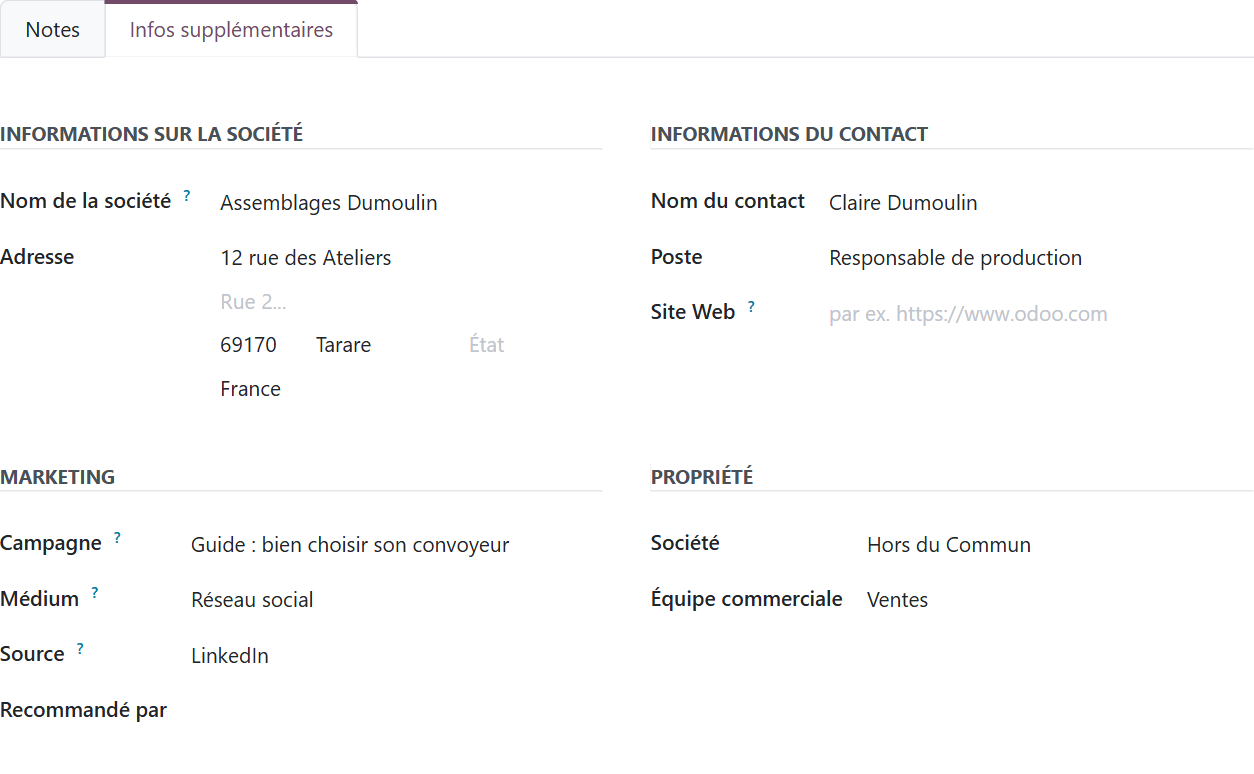
In this example, the production manager of an assembly workshop came in through the “Choosing the right conveyor” guide, after a LinkedIn post. The MOFU content did its job, and the CEO can see it. Opportunities can then be grouped by campaign, medium or source: over several months, you see which guides and which channels produce opportunities, and which ones don't. How these fields get filled in depending on your forms and campaigns should be checked during configuration.
The contact created by the content still has to be followed up afterwards, nurtured and qualified all the way to the quote. Our CRM page covers this part, from the pipeline to automated follow-ups, including forms, email campaigns and lead scoring: CRM and sales management with Odoo.
Which mistakes should a B2B SME avoid when getting started?
Five mistakes come up again and again in content strategies that run out of steam.
Publishing only BOFU. A string of posts like “new product”, “meet us at the trade show”, “discover our offer” only speaks to customers who are already convinced. Prospects discovering their problem never find you.
Publishing only TOFU. Conversely, discovery articles with no guide or case study behind them attract readers who leave without a trace. Every piece of TOFU content must lead somewhere.
Writing for everyone. Content that tries to speak to the CEO, the buyer and the technician at once convinces none of them. Choose one reader per piece of content.
Working without the sales team. Salespeople know the customers' questions, objections and words. An editorial calendar built without them misses the best topics, and the BOFU content produced never gets sent.
Judging too early. B2B content pays off over the length of the sales cycle. A review after three weeks only tells you it is too early.
In short: start from your customers' real questions, sort them by the point in the journey where they come up, give each one the format that suits it, and track in your CRM what each piece of content brings in. The rest is a matter of consistency.
- Content Marketing Institute, B2B Content Marketing Benchmarks, Budgets, and Trends: Outlook for 2025: https://contentmarketinginstitute.com/b2b-research/b2b-content-marketing-trends-research-2025
- Odoo, official documentation 19.0, Link Tracker: https://www.odoo.com/documentation/19.0/fr/applications/websites/website/reporting/link_tracker.html

Article written by Billy Felicie
Odoo integration expert at Hors du Commun (Lyon). I have been helping SMEs implement their digital tools and optimize their business processes for more than 5 years.