
To set up a B2B customer referral program, you first decide who to ask and when, then set a simple reward and a single way to track each referral in the CRM, all the way to the signed deal. A B2B referral program comes down to five decisions: who refers, when you ask, what you offer, how you track, how you say thank you.
The rest is discipline. In B2B, customers number in the dozens or hundreds, not thousands, and a single referral can be worth a large contract. So referrals there look nothing like e-commerce promo codes: it is a sales approach in its own right, managed like an acquisition channel, with its own rules, tracking and numbers.
What is a B2B customer referral program, and how does it differ from B2C?
A customer referral program organizes something that already happens: a satisfied customer tells a peer about you. The program makes this more frequent, easier, and above all measurable. Without a program, referrals arrive at random, nobody knows where the prospect came from, and the customer who made the referral is never thanked.
In B2B, three differences change how you go about it.
- The referrer is a person inside a company. The plant manager who recommends you puts his own credibility on the line with a peer, not just his company's.
- The sales cycle is long. Months can pass between the referral and the signature: without written tracking, the origin of the contract is forgotten long before the invoice.
- The reward matters less than the recognition. An industrial buyer does not recommend a supplier for a gift voucher. He does it because the service was good and he wants to help out a peer.
Referrals are the most concrete form of what is called an ambassador program: you move from loyalty, which brings the customer back, to advocacy, which brings in other customers. Our page on this topic offers a downloadable guide to the 6-step community journey, the 8 rules that make the difference and the KPIs to measure your community: the secret to turning your customers into loyal ambassadors.
Which customers should you ask, and when should you ask them?
Not every customer makes a good referrer. The right candidate has three traits: they are satisfied, they say so, and they know companies that look like your targets. A very happy customer who is isolated in their industry will rarely refer anyone. An average customer with a strong network can open doors for you, provided the service on their own account is flawless.
To spot them, start from facts rather than impressions:
- customers who reordered or renewed without tough negotiation;
- those who have already left a review, agreed to a testimonial or referred someone spontaneously;
- those with a high Net Promoter Score (NPS), if you measure it;
- those whose contact person is active in a professional network, a business club or a trade federation.
Timing matters as much as the person. You ask for a referral right after a proven positive experience: a delivery made on a tight deadline, a successful commissioning, a problem solved quickly, an annual review where the customer voiced their satisfaction themselves. Asking at signing is too early: the customer has not experienced anything yet. Asking in the middle of a complaint is counterproductive.
One simple rule helps: make the referral request a step in customer follow-up, triggered by a specific event. A completed commissioning, for example, can trigger an “Ask for a referral” activity for the account's salesperson. The request then no longer depends on anyone's memory.
What reward should you offer a B2B referrer?
The reward does not create the referral, it says thank you for it. In B2B, recognition often works better than money. A few options, from the lightest to the most committed:
- a personal thank-you from the CEO, by phone or in writing, as soon as the referral comes in;
- early access to something new, a tester role on a new product, an invitation to an exclusive event;
- a commercial benefit on the next order, or a free service, reserved for the referrer's company;
- a donation to a charity chosen by the referrer, useful when their company's rules forbid any personal benefit.
That last point is not a detail. Many companies set rules on the gifts their employees may receive from suppliers. A personal benefit given to a customer's buyer can put them in an awkward position with their own management. A benefit given to the referrer's company, not to the person, avoids that discomfort.
Two other questions are settled before launch, not after. First, when is the reward due: at the referral, at the first meeting, at signing or when the first invoice is paid? Second, what is its accounting and tax treatment: a discount on an invoice, a business gift and a finder's fee are probably not treated the same way. Have your accountant confirm this point before announcing anything to your customers.
Think about the referred company too. A welcome benefit for the referred company (a free assessment, an assisted onboarding) gives the referrer a good reason to talk about you: they are not asking their peer for a favor, they are doing them one.
How do you ask for a referral without being pushy?
Many satisfied customers do not refer anyone because nobody asks them, or because they are asked the wrong way. “If you know anyone, feel free” produces almost nothing. An effective request is specific, short and easy to act on.
Specific first: describe the type of company you are looking for. “Do you know the owner of a machine shop, with 20 to 50 employees, who has the same scheduling headaches you had last year?” brings a name to mind. “Do you know anyone?” brings none.
Easy next: the referrer should have almost nothing to do. Offer two options to choose from: an introduction through a three-way email, or passing on your contact details with an introduction already written. The more you write for them, the more likely they are to act.
This introduction should fit in a few sentences the referrer can repeat effortlessly: what you do, for whom, and the result you achieved for them. That is exactly the short pitch exercise. Our guide on the topic offers a six-step structure and 30-second, 90-second and 2-minute scripts; the shortest can serve as the basis for the text the referrer will pass on: convert quickly with a simple, effective sales pitch.
Finally, ask for permission before contacting the referred company on their behalf. A prospect called “on behalf of” someone who did not give them a heads-up is a wary prospect, and an offended referrer.

You when the prospect calls saying “Paul told me about you” and half of the convincing is already done.
How do you track referrals in the CRM?
This is where many programs fail. A referral that is not recorded when the opportunity is created is quickly lost: six months later, at signing, nobody remembers where the contact came from. You then cannot thank the referrer, calculate their reward or know whether the program pays off.
In Odoo's CRM, two standard fields are enough, with no custom development. They are on the opportunity form, in the “Extra Info” tab, “Marketing” section:
- the “Source” field, where you pick a dedicated source, for example “Customer referral”, created once and for all;
- the “Referred By” field, where you enter the name of the referrer and their company.
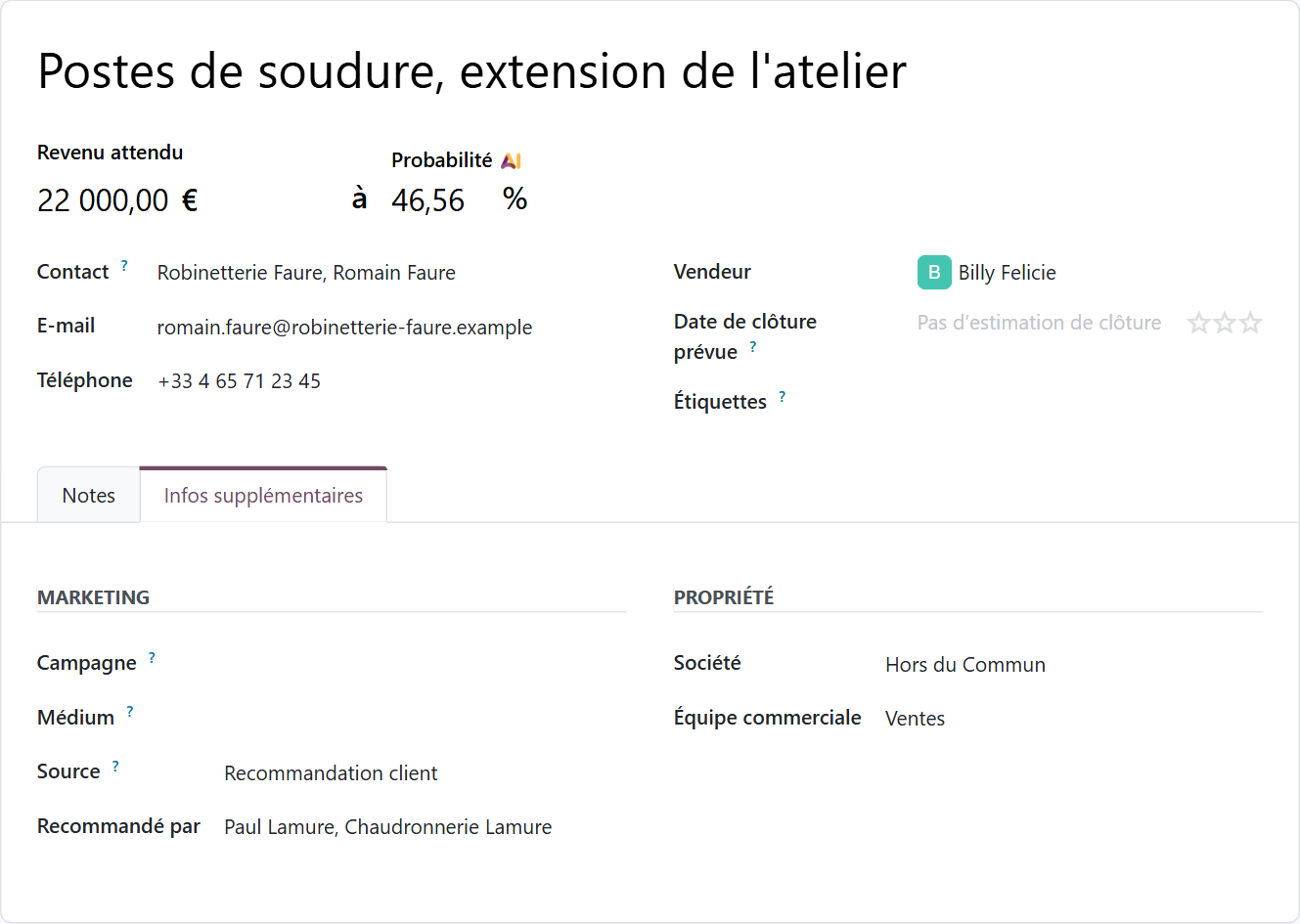
Two precautions prevent misleading statistics. The source must be unique: if one salesperson picks “Customer referral”, another a different source and a third nothing at all, no report will be accurate. And “Referred By” is a free-text field: always write the name the same way (first name, last name, company) so you can find all referrals from the same referrer with a search.
The source has another use. Odoo calculates a probability of success for each opportunity, predictive lead scoring, and the source is one of the possible variables in that calculation:
“This can include variables such as the assigned Salesperson, the lead's source, the lead's language, and other historical and demographic data.” (Official Odoo 19 documentation, Assign leads with predictive lead scoring)
If the Source variable is enabled in the predictive lead scoring settings, the history of referred opportunities, won or lost, therefore feeds into the probability shown on new ones. That still requires the source to be filled in rigorously.
This tracking is only one piece of a well-run CRM, with its pipeline stages, automated follow-ups and management dashboards. Our page on Odoo CRM describes how we set it up, with these three pillars and a seven-step approach, from needs analysis to updates: CRM and sales management with Odoo.
How do you close the loop with the referrer?
A referrer who never hears back rarely refers twice. They took a risk for you with a peer; they want to know how it turned out. Let them know at every step that concerns them: first contact made, meeting held, contract signed or not. Even a “it didn't work out, but thank you” beats silence.

You when you recommended your supplier to two peers six months ago and nobody ever thought to say thank you.
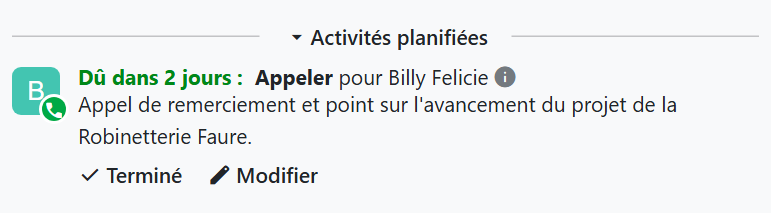
In Odoo, the simplest way is to schedule an activity on the referred opportunity, assigned to the salesperson: a thank-you call as soon as the referral comes in, then another at signing. The activity appears on the opportunity, in the planned activities area, with its due date.
That leaves the reward. If it is due at signing or payment, you need to follow the opportunity through to the quote, then to the invoice, to know when to trigger it and on what amount. When CRM, quotes and invoicing live in the same tool, the prospect's data follows the deal all the way to payment, with no re-entry. We explain what this consolidation changes for sales reps' time, reliability from quote to payment, and management in our article why centralize CRM, quotes and invoicing in Odoo.
Which KPIs should you track to know if the program works?
A referral program is judged on a few numbers, tracked every month. Most are calculated from the opportunities' source, which is why it must be filled in without exception.
| KPI | What it tells you |
|---|---|
| Number of referrals received | Whether your customers play along, and whether you ask often enough |
| Conversion rate of referred opportunities | Whether referrals are qualified, compared with other sources |
| Share of revenue from referrals | The channel's real weight in your sales |
| Number of active referrers | Whether the program relies on two loyal customers or on a real base |
| Time to say thank you | Whether the loop is closed, the condition for a referrer to do it again |
In Odoo, the CRM ‣ Reporting ‣ Pipeline menu lets you group opportunities by “Source”, and so compare channels with each other. Compare referred opportunities with the others over the same period: that is how you find out whether referrals deserve more effort than trade shows or prospecting.
Finally, give the program time to produce results. In B2B, the first referrals can take months to turn into revenue. Look first at the number of referrals and active referrers, then at revenue.
Should you use Odoo's Referrals app for your customers?
No, and the confusion is easy to make. Odoo offers an employee referral app, which its French documentation sometimes calls “Referrals”, sometimes “Parrainages”. It is used for recruitment: employees refer candidates, not customers referring prospects.
“Users can refer people they know for job positions, then earn referral points as those people progress through the recruitment process.” (Official Odoo 19 documentation, Referrals)
The same documentation states that the Employees, Recruitment and Website apps must be installed for it to work. None of this concerns your customers. For customer referrals, the CRM is enough: a dedicated source, the “Referred By” field, thank-you activities and tracking all the way to the invoice.
In short, a B2B customer referral program succeeds less through a generous reward than through consistency: asking at the right time, making it easy for the referrer, tracking every referral and saying thank you every time. Configuring the CRM takes only a few minutes. The sales team's discipline, on the other hand, is built over time.
- Odoo, official Odoo 19 documentation, “Assign leads with predictive lead scoring”: https://www.odoo.com/documentation/19.0/fr/applications/sales/crm/track_leads/lead_scoring.html
- Odoo, official Odoo 19 documentation, “Referrals”: https://www.odoo.com/documentation/19.0/fr/applications/hr/referrals.html

Article written by Billy Felicie
Odoo integration expert at Hors du Commun (Lyon). I have been helping SMEs implement their digital tools and optimize their business processes for more than 5 years.