How much does an Odoo project cost, and how do you finance it?
Changing your information system is not a software purchase: it is a structural investment for your business. What really makes up the bill? Which traps make costs explode? And above all, which bank financing options and government grants can help fund the project? Let's talk numbers, with full transparency.
Go straight to financing solutions1. Budget estimate: 1% to 4% of revenue
However, this percentage varies widely depending on your business model. For example, a trading company (buying and reselling goods) generates very high revenue but with thinner margins, so its ERP budget will naturally be a smaller percentage of its total revenue. Conversely, a service company with high margins will have a different ratio.
In practice:
- Around 1%: For companies with very standard flows and few specific needs.
- 2% to 3%: The average for a typical SME project covering the entire value chain.
- Up to 4%: For companies with very complex needs (advanced multi-warehouse inventory, complex trading flows, dropshipping, multiple API integrations, made-to-order manufacturing).
| Company revenue | Year 1 investment (1 to 4% depending on complexity) |
|---|---|
| 1 000 000 € | €10,000 to €40,000 |
| 2 500 000 € | €25,000 to €100,000 |
| 5 000 000 € | €50,000 to €200,000 |
| 10 000 000 € | €100,000 to €400,000 |
2. Year 1 vs. the following years
- Implementation (the first-year cost): This is the largest share at the start. It pays for our work as an integrator: audit, scoping, configuration, data migration, any custom development, and training your teams on the new software.
- The software subscription (recurring cost): This is the share that goes to the software publisher (Odoo SA). It is calculated per user and depends on the hosting option. You pay it in the first year, but also every year after that.
- Maintenance and ongoing support (recurring cost): From year 2 onward, the financial effort drops sharply. But you absolutely need to budget for support from a partner. It covers answering your users' questions, adapting the software to your new needs and, above all, carrying out the annual version upgrade so you do not fall behind technologically.
3. The crucial concept of technical debt
When you ask an integrator to code a custom feature (instead of slightly adapting your processes to use standard Odoo), you meet an immediate need. But you take on a “debt.”
Every year, when Odoo is updated, that custom code will have to be reviewed, fixed and adapted to keep working. That is the interest rate on your debt. The more heavy development you ask for, the more expensive your software becomes to maintain over the long term, until it turns into a financial burden.
🔗 Go further: To keep this debt in check, our team will always challenge your custom development requests. Learn about our approach in our expert article: How to customize Odoo (and when to avoid it).
4. What really makes the bill explode
- Massive historical data migration: Extracting, cleaning and importing 10 years of old invoices and dead quotes costs thousands of euros in technical work, for data nobody will ever look at.
- Unjustified development: Trying to recreate your old software's interface in Odoo out of pure resistance to change. You end up spending days coding just for visual comfort.
- Overengineered connectors: Trying to sync Odoo in real time with a complex API or an outdated tool used only three times a month, instead of accepting occasional double entry.
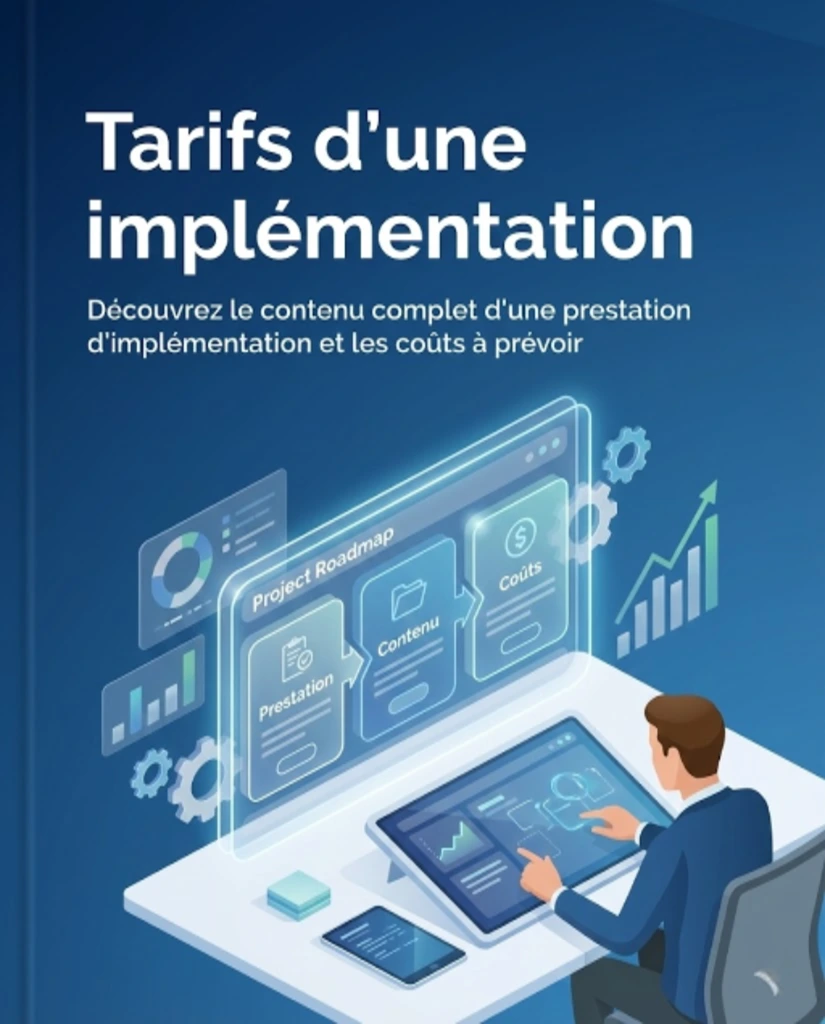
Estimate the cost of your project
Discover everything included in an Odoo implementation engagement, and the real costs to plan for.
5. Possible vs. Profitable
We reject that approach. The question is not whether we can do it. The question is whether it is profitable for you to spend that money.
If a development costs €5,000 to save one team member 2 hours of clicking a month, the return on investment will take years. That is waste. We will tell you no.
6. Our working philosophy
We look for the exact spot where we can move your business forward dramatically, in as little time as possible. Anything that falls under marginal optimization is pushed to the following year, once your teams have fully mastered the basics of the software.
🔗 Go further: For these budget reasons, we turn down “tunnel” projects that drag on for 18 months and drain cash flow. Discover our methodology built on short waves in the guide How to run an Odoo implementation.
7. Bank loans and technology leasing
- Bpifrance digital transformation loan: Bpifrance (French public investment bank), for example, offers the “Boost Transformation numérique” loan for small businesses and SMEs (up to 49 employees). It is designed to finance software, consulting and training. Amounts range from €5,000 to €100,000, over 3 to 5 years, with no collateral or personal guarantee, and a repayment deferral of up to 12 months.
- Innovation investment loan: Some traditional banks finance intangible expenses (such as an ERP implementation) if the application is presented as an innovation project. For example, Banque Populaire offers the “Innov&Plus” scheme for companies with fewer than 500 employees.
- Technology rental and leasing: Many financing subsidiaries (such as BNP Paribas Leasing Solutions, or Crédit Agricole with its “Location Opérationnelle Informatique” IT rental offer) help smooth out cash flow. They finance up to 100% of the digital transformation (software, services and hardware) through monthly or quarterly payments, which are booked directly as operating expenses.
8. Grants, OPCO and government support
- Coverage by your OPCO (training): A large part of an implementation project is actually skills transfer. It is very common to have the training portion of the project funded by your skills operator (OPCO, the French training funding body). The coverage rate and cap depend on your OPCO, your industry and the size of your company: check them with your OPCO before starting the training.
- Support for industrial SMEs: Regional authorities and the French government often roll out funding dedicated to the digitalization of industry (Industry 4.0 plan). If you are an industrial SME, some local programs can cover between €10,000 and €40,000 of your software investment.
Yes, grants can bring massive cost reductions. But they come with a much longer timeline. Funding applications take time to prepare, review and approve (often 3 to 6 months of waiting). If your project absolutely has to start next month for business reasons, waiting for financial aid will stall your company's momentum.
In conclusion: Government and OPCO funding is a great bonus that you should make the most of, but an ERP remains a strategic investment that the company must fundamentally be able to afford in order to move forward.

Make your project a success with our support
From audit to training, secure your ERP rollout. Request your strategic assessment, 100% free and with no commitment.
By phone or video call, at a time that suits you.
Hors du Commun • Odoo integrator in Lyon
Budgeting • Project scoping • Long-term partner