
Yes, for the most part: with Odoo, e-invoicing is free on the transmission side, because sending and receiving invoices through Odoo's approved platform is charged neither per invoice nor through an extra module to buy. What you pay for is the Odoo license you need for the rest of your business management, a few credits for ancillary services, and above all the time it takes to get your invoicing data in order.
The distinction matters, because the reform requires every company to go through an approved platform (PA, France's certified e-invoicing platform) and most of these platforms make money one way or another. This article sorts things out, item by item, between what Odoo includes, what you pay for, and what costs time without appearing on any invoice. The screens shown are from Odoo 20; it works the same way in Odoo 19.
What is really free in Odoo e-invoicing?
Odoo is not just software that is “compatible” with the reform. Odoo itself has been registered as an approved platform by the French tax authorities since April 2026. In practice, your Odoo database exchanges directly with the other platforms and with the authorities, with no extra intermediary to subscribe to.
What is included, with no pay-per-use charge:
- registering your company on Odoo's approved platform, from the accounting settings;
- registration on the Peppol network, which follows automatically, with no separate procedure;
- sending your customer invoices in a structured format, from the invoice's “Send” button;
- receiving your vendor bills, which Odoo retrieves several times a day and creates as drafts in your purchase journal;
- e-reporting, that is, transmitting to the authorities the data on your sales to private individuals and your international transactions.
Odoo states it in black and white on the page for its Invoicing app:
“Send and receive […] customer invoices and vendor bills, for free, with no time limit.” (Odoo, Invoicing app page, odoo.com, viewed on October 17, 2026)
Activation itself comes down to one button in the settings. The approved platform module is part of Odoo's French localization: there is nothing to order, just a registration to complete.

Behind this button, registration requires the email address of a legal representative, a code received by email, an ID document, the electronic signature of the approved platform designation form and the company's SIREN (French company registration number). It is free, but it must be done by a legal representative of the company: set aside time in the business owner's calendar, not just in the accounting department's.
Why is cost an issue for every SME?
Because nobody escapes it. All businesses subject to VAT (TVA) must be able to receive e-invoices since September 1, 2026. Large companies and mid-sized companies (ETI) are already issuing them. For everyone else, the official timeline is clear:
“September 1, 2027: small businesses and micro-enterprises must be able to issue their invoices electronically and transmit their e-reporting data.” (French Ministry of the Economy, “Tout savoir sur la facturation électronique pour les entreprises”, reform timeline, economie.gouv.fr)
Next, because the government does not provide the exchange tool. It chose a model based on specialized platforms, approved by the authorities, which are the mandatory intermediary for every invoice exchanged between businesses. A PDF sent by email is no longer enough: the invoice must be sent in a structured format and go through an approved platform. So every company has to choose one, and each platform sets its own terms: monthly subscription, price per invoice, a free basic plan with paid options, or a service included in business management software.
This is where the question “is it free?” becomes a real question for a business owner. A platform can be free for receiving and paid for sending, free up to a certain volume of invoices, or free but separate from your business management software, which forces you to move invoices back and forth between two tools. The right calculation is not the entry price, it is the total cost: subscription, re-keying, reconciliations, and time spent getting the tools to talk to each other.
With Odoo, this two-tool problem disappears: the platform and the invoicing software are the same product. We have gathered what you need to know about the reform, from the timeline to formats and penalties, on a dedicated page, which we invite you to read here: e-invoicing with Odoo.

You, when a software publisher writes “free” in big letters and you are already looking for the asterisk at the bottom of the page.
Do you need to pay for an Odoo license to use the approved platform?
Transmitting invoices is free. Using Odoo depends on your plan. There are three possible situations.
1. You only use invoicing
Odoo offers a “One App Free” plan: a single app, with no license to pay, on Odoo Online. If that app is Invoicing, you issue your invoices, receive your vendors' bills and go through the approved platform without paying for a license. For a freelancer or a very small business that just wants to be compliant, this is a very economical answer, provided you are willing to invoice from Odoo.
2. You already use Odoo to run your business
This is the case for SMEs that already run sales, purchasing, inventory and accounting in Odoo. E-invoicing then changes nothing about the license. On the software side, the cost of compliance is zero: you already pay for your users, and the approved platform comes with them.
3. You are switching to Odoo because of the reform
Then you need to budget for the license as with any Odoo project. Here are the public prices noted on odoo.com on September 27, 2026, with an annual commitment:
| Odoo plan | Public price per user per month | What it covers |
|---|---|---|
| One App Free | No license, for a single app | A single app, for example Invoicing, on Odoo Online |
| Standard | €19.90 for 12 months, then €24.90 | All apps, on Odoo Online |
| Custom | €35.90 for 12 months, then €44.90 | All apps, plus Studio, external API, Odoo.sh or your own servers |
One point that is often confused: filing VAT returns via EDI from Odoo is a different service, and Odoo's documentation states that it requires a valid Odoo Enterprise subscription. Do not mix the two topics in your calculation: the approved platform concerns invoices, while the VAT return remains a separate flow.
What credits or extra fees should you plan for?
Odoo sells credits separately for certain services that use resources on the publisher's side. Its pricing page lists several, not included in the plans: SMS, contact autocomplete, lead generation, and the artificial intelligence that reads vendor bills and expense reports.
This last item is the one that directly affects invoicing. As long as your vendors send you PDFs, Odoo can digitize them to prefill the vendor bill, and each scan uses credits. The setting is in the Accounting settings, Digitization section.
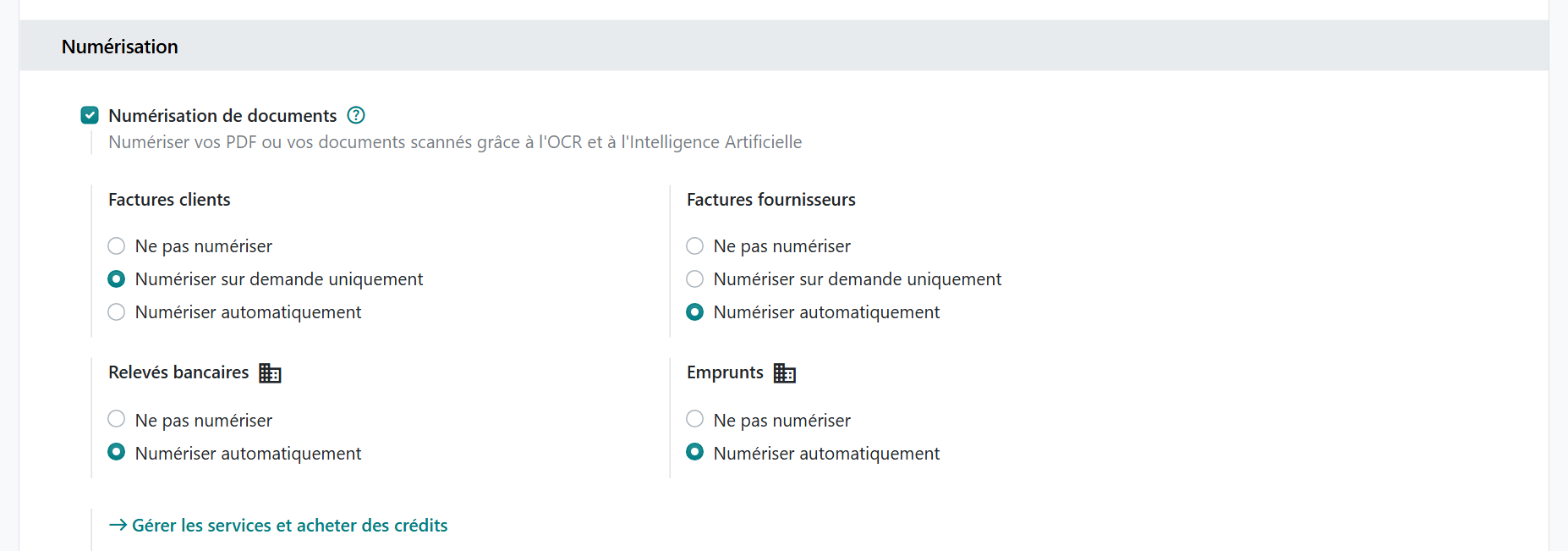
Here the reform works in your favor. An invoice received through the approved platform arrives already structured: Odoo imports it automatically and creates it as a draft in your purchase journal. The data comes from the file itself, not from reading the PDF: logically, AI digitization no longer has any reason to step in. As your vendors switch to electronic invoicing, between 2026 and 2027, the share of invoices to digitize shrinks, and your credit purchases with it. Keep automatic digitization during the transition, then monitor consumption: you will still receive PDFs from foreign vendors, outside the scope of the reform.
Another special case is the public sector. Invoices for central government and local authorities go through Chorus Pro, which remains the public sector's invoicing portal. Odoo sends them there via the Peppol network, with a dedicated French localization module to install, and a Chorus Pro account to create on your side.
Where is the real cost of compliance hiding?
Not in the software. In your data. Odoo knows how to receive and issue e-invoices. What gets in the way almost every time, at the companies we have brought into compliance, is the existing invoicing: poorly configured products, inconsistent VAT rates, accounting that has not kept up with the company's growth.
The approved platform is demanding, and that is normal: it transmits data that the authorities will use. Before anything is sent, Odoo and the reform set precise conditions:
- every French customer must have their company identifier (SIREN) filled in on their record, and be verified in the e-invoicing directory;
- every invoice line must carry a product or a label, and exactly one tax;
- the company registers with its SIREN, and the e-reporting frequency, set in the settings, must match its VAT regime: the authorities set the transmission frequency according to that regime.
Take a wholesale SME that has been invoicing 300 business customers for ten years. If half the records have neither a SIREN nor a VAT number, they need to be completed, one by one or by import, then verified. If some products carry two taxes, or none, every affected invoice will be blocked when sent. None of this costs anything in licenses. All of it takes days.

You, when the approved platform is free, but your 300 customer records without a SIREN are not.
That is why we start every compliance project with a meeting with the accountant. The goal: make sure the tax and account configuration matches the company's reality, and that no VAT return goes out wrong once the flows are automated. Once the data is clean, bank reconciliation, bookkeeping and exchanges with the accounting firm also become more reliable. We detail this organization on our page dedicated to SME accounting in Odoo.
In terms of time, bringing a company into compliance generally takes two to three days of work, then more depending on your needs: invoicing the public sector, several companies, point of sale sales subject to e-reporting.
What if you are still on Sage, EBP or another software?
With your current software publisher, there are two possible cases: either it is an approved platform itself, or its software is a compatible solution connected to an approved platform. Ask it three specific questions. Is transmission included in your current subscription, or charged extra, per invoice or per month? Do vendor bills you receive go straight into your accounting, or do you have to download them from a portal? Is e-reporting of sales to private individuals automatic?
If the answers force a second tool and re-keying on you, the reform is the right time to switch: if you have to overhaul everything for compliance anyway, you might as well do it on software that will carry you forward. If your current tool answers properly, nothing forces you to change it just for e-invoicing. For Sage users, we have compared the two software packages point by point, accounting and licenses included, in our comparison of Odoo 19 and Sage 100.
Beware of the opposite argument. Switching to Odoo because its approved platform is free, without looking at anything else, would be a bad decision: the cost of changing software lies in data migration, configuration and training your teams, not in transmitting invoices.
How do you estimate the real budget for your move to e-invoicing?
Do the math in five lines, over one year, rather than comparing entry prices.
- The license: nothing extra if you are already on Odoo, nothing either with the Invoicing app alone, otherwise the number of users multiplied by the plan's price.
- Transmission: no cost per invoice with Odoo's approved platform, to be compared with the subscription or per-invoice price of another platform.
- Credits: digitizing vendor bills still received as PDFs, which should shrink as the reform becomes widespread.
- Getting the data in order: customer records, taxes, products, VAT regime. This is the most variable item, and the only one that depends on your history.
- Internal time: registration by the business owner, validation by the accountant, the team getting to grips with the new invoice statuses.
With Odoo, the first two lines are often at zero. The budget comes down to the last two. To put this workstream in the context of an entire Odoo project, including licenses, integration, training and funding options, we have detailed the costing method on our page cost and funding of an Odoo project for an SME.
In short, e-invoicing is free with Odoo in the strict sense: the approved platform charges nothing for registration, sending or receiving. What costs something is having data clean enough for every invoice to go through the first time. At Hors du Commun, an Odoo integrator in Lyon, that is precisely what we work on with the SMEs we support, well before the September 2027 deadline rather than the day after.
- French Ministry of the Economy, “Tout savoir sur la facturation électronique pour les entreprises” (everything businesses need to know about e-invoicing; reform timeline): https://www.economie.gouv.fr/tout-savoir-sur-la-facturation-electronique-pour-les-entreprises
- Odoo, Invoicing app page (e-invoicing, approved platform): https://www.odoo.com/fr_FR/app/invoicing

Article written by Billy Felicie
Odoo integration expert at Hors du Commun (Lyon). I have been helping SMEs implement their digital tools and optimize their business processes for more than 5 years.