
For an SME with 10 to 50 employees, going through an Odoo partner is most often the best choice: the Odoo license costs the same as when you buy direct, and you gain a single point of contact who scopes the project, configures the software, migrates your data and trains your teams. Buying Odoo directly on odoo.com makes sense mainly for a simple need, a few standard apps and a team ready to configure everything itself, possibly with a Success Pack sold by Odoo.
This question deserves a straight answer, even coming from an Odoo partner like us. Here is what each option includes, what Odoo's contract says, and how to decide.
Odoo partner or buying direct: what is the short answer?
There are not two Odoos. The software, the subscription contract and the hosting are the same, whether you subscribe on your own on odoo.com or through a partner. What changes is everything around the license: who analyzes your processes, who configures, who trains, who answers when something gets stuck.
In practice, you have three paths, not two. Buying direct without support: you subscribe, you configure, you train your teams. Buying direct with a Success Pack: Odoo sells you a block of hours with a consultant, in remote sessions. Subscribing through an official partner: an integrator runs the project end to end and remains your point of contact after go-live.
| Criterion | Direct only | Direct + Success Pack | Odoo partner |
|---|---|---|---|
| License price | List price | List price | List price, discount possible depending on commitment |
| Analysis and configuration | By you | Odoo consultant, within the block of hours purchased | By the partner, on a defined scope |
| Format | Self-service | Scheduled sessions by phone or online | Remote and on-site workshops |
| Day-to-day contact | Odoo support | Odoo support and consultant during the project | The partner, who escalates to Odoo if needed |
| Custom development | No | Billed separately, by the day | Possible, to be scoped and quoted |
Does the Odoo license cost more through a partner?
No. It is the most widespread misconception, and it is wrong: going through a partner adds nothing to the price of your subscription. You pay the license at Odoo's list price, under the same rules.
The prices listed on the odoo.com pricing page for France are, with annual billing, €19.90, then €24.90 per user per month for the Standard plan, and €35.90, then €44.90 for the Custom plan. The first amount is a first-year discount, valid for 12 months for the users in the initial order. The Light User license costs €7.90 per month.
Two recent changes affect the calculation. Odoo raised its prices on September 24, 2026. And an employee listed in the Employees app without a user account is now billed, with the Light User license as the solution in that case. A fitter or a warehouse clerk who never logs in therefore counts on the invoice as soon as they appear in Employees.
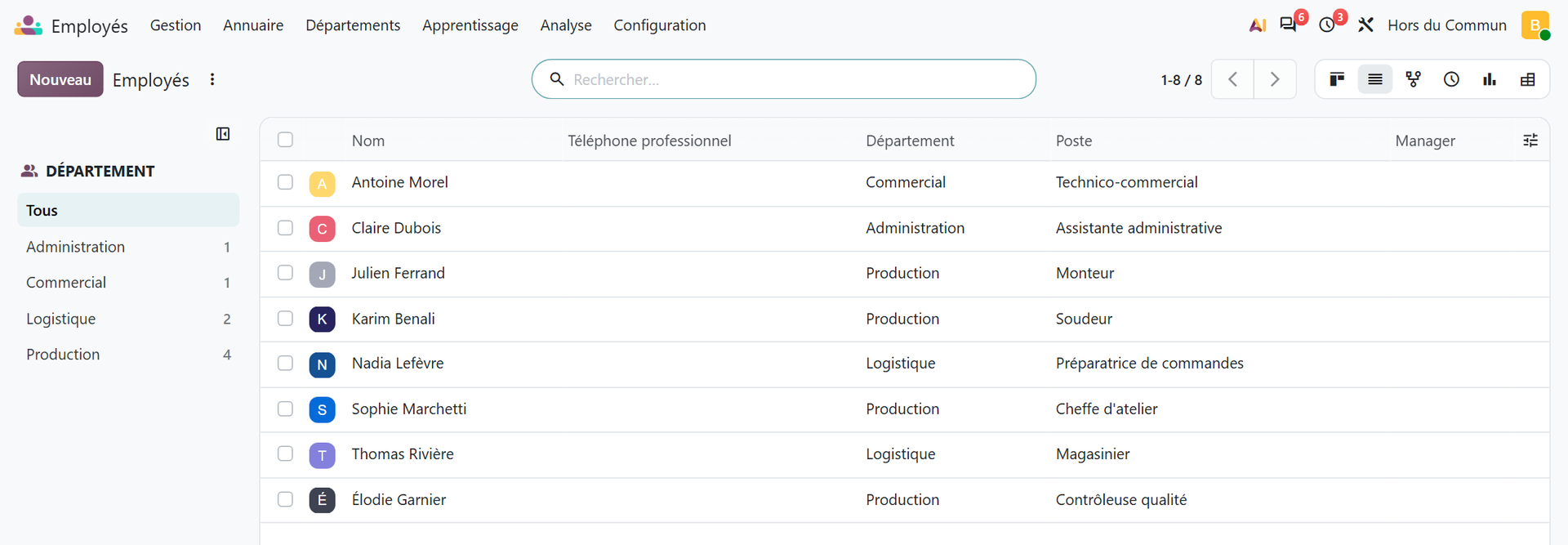
Odoo's AI features also consume credits purchased separately. How many full accounts, how many Light Users, which plan: that is precisely the sizing a partner does with you before the order.
Going through a partner can even cost less. Odoo grants discounts based on the company's commitment, and a partner knows what to negotiate and with whom. With us, the discount obtained on the license averages 3% to 10%, depending on your commitment. If the license price is your first criterion, we have sorted out the real discounts from the fake promo codes circulating online, in a page you can read here: the real ways to pay less for your Odoo license.
What does buying direct from Odoo really include?
Subscribing direct gives you all the apps in the chosen plan, hosting on Odoo Online, updates and Odoo support. That is a lot, but it is not a project.
Odoo says so on its pricing page: among what is not included in the plans are the implementation service and access to an Odoo expert's services, as well as maintenance of custom code. The support included with the subscription covers software bugs and questions about using standard features. Customizations fall under a separate contract.
Take the replenishment rules screen of the Inventory app. Odoo support will explain how it works. It will not tell you which minimums to set, whether to buy or manufacture, or how to organize your delivery routes. Someone has to make those decisions. When you buy direct without support, that someone is you.
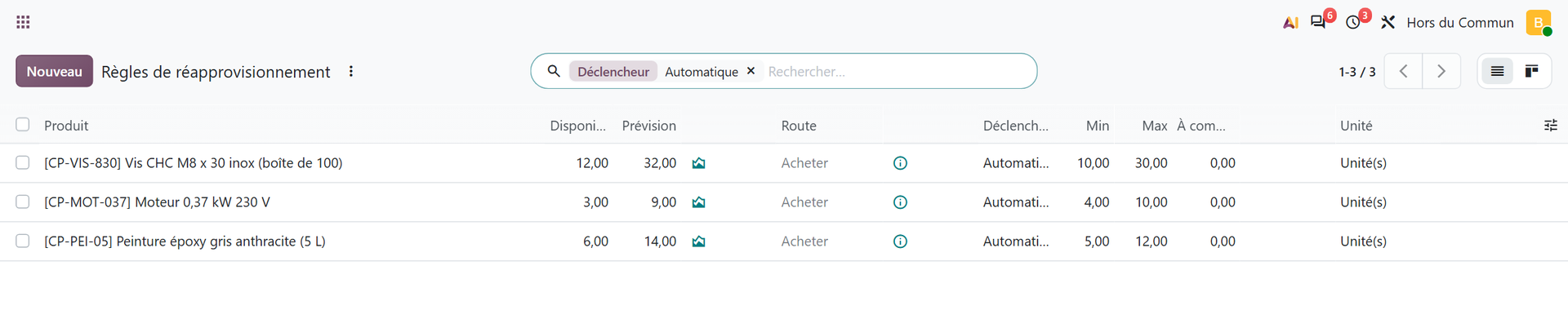
Buying direct works well for a services company starting with CRM, quotes and invoicing, and clean data. It becomes risky as soon as flows intersect: inventory and production, purchasing and quality control, accounting and e-invoicing.
Is Odoo's Success Pack enough for an SME?
The Success Pack is Odoo's answer to the need for support. According to the official page, it is a set of services delivered by a dedicated consultant: needs analysis, configuration, training. Packs range from 4 hours (Starter) to 200 hours (Pro), with 25, 50 and 100 hours in between. Odoo backs this service with a striking figure:
“98% implementation success rate, compared to 65% without a Success Pack.” (Odoo SA, official Success Packs page, accessed October 2026)
The figure comes from the vendor, with no methodology: it is a sales argument. Its message still holds for every option: going it alone is the riskiest scenario. The real debate is therefore not “supported or not”, but “supported by whom, and how”.
Three points on the page deserve your attention before you sign. The service is organized in scheduled sessions, by phone or online; on-site consulting exists, but travel time and expenses are billed on top. The number of hours is set in advance based on the apps chosen, and consultants do “their best” to get you started within that time: beyond it, you have to buy more hours. Finally, development is billed per consulting day, with monthly fees for maintaining the added code.

You when you try to fit your inventory, your production and your accounting into a 25-hour Success Pack.
Odoo itself steers companies according to their size: on its pricing page, it points small businesses to Success Packs, and states that companies with more than 50 employees usually work with a partner offering localized project management. An SME with 10 to 50 employees sits exactly on the border. It is the complexity of your flows, not your headcount, that should tip the balance.
What does an Odoo partner actually change?
The partner's role is not a sales invention: it is provided for in Odoo's subscription agreement.
“For bug fixes, support and upgrade services, the Customer may either work with an Odoo Partner as the main point of contact, or work with Odoo SA directly.” (Odoo Enterprise Subscription Agreement, section 4.6, Odoo 19.0 documentation)
The same agreement specifies that the partner can call on Odoo SA for second-level assistance on standard features. You lose nothing of the vendor's support: you gain an intermediary who knows your database, your processes and your history, and who knows how to ask the technical question on your behalf.
Beyond support, a partner brings what the subscription does not include:
- scoping: understanding how the company really works, and deciding what goes into Odoo first;
- configuration: translating your business rules into standard settings rather than custom development;
- data migration: customers, products, bills of materials, balances, cleaned before import;
- role-based training, on your own data, so the tool is genuinely adopted;
- ongoing support after go-live, when real-life questions come up.
At Hors du Commun, an official Odoo partner in Lyon, subscribing through us also brings three things a direct subscription does not. We extend your trial database to up to 60 days, so you can test the software over a real monthly cycle, closing included. We negotiate the license based on your commitment. And we get a seat for your accountant, with accounting firms that are Odoo partners or by negotiating access for your current firm. These three benefits, and the way we run a deployment until your teams are self-sufficient, are presented on a page we invite you to read: subscribe to Odoo through an official partner in Lyon.
Why does an SME with 10 to 50 employees benefit from going through a partner?
Because in an SME, there is no ERP project manager. There is a business owner, sometimes a finance and administration manager, who carries the project on top of their day job.
We saw this with the small businesses and SMEs we supported as part of a program run by a local authority. These companies, with 3 to 49 employees, had three things in common: none had an IT department, none had a flexible project budget, and all had a business owner who followed the project personally, on top of their day job. The lesson: in this context, every hour spent looking for the right setting is an hour taken away from running the company.
A partner makes up for this gap. It brings a method proven on other projects, it knows which questions to ask before touching the software, and it spots early the gaps between your needs and the standard. That is where the budget is decided: a gap discovered during scoping is resolved by a configuration choice; the same gap discovered after go-live is often resolved by custom development or by migrating data again.
This is especially true when apps intersect: a poorly designed bill of materials skews purchasing, which skews inventory, which skews the margin.
How do you choose between buying direct and a partner for your case?
Answer these five questions honestly. If you answer “yes” to two or more of them, go through a partner.
- Will you use more than three or four interconnected apps? Sales, inventory, purchasing and accounting form a system: a setting in one changes how the others behave.
- Do you have data to migrate? Customer file, product catalog, bills of materials, accounting balances: the import is often the most underestimated part of a project.
- Does your business have specific rules? Manufacturing, quality control, traceability, customer-specific pricing, staggered deliveries.
- Does your team lack the time to carry the project on top of its daily work, for several months?
- Do you need on-site workshops with your teams, on the shop floor or in the warehouse?
Conversely, buying direct is a rational choice if you start with one or two standard apps, with no history to migrate, and a curious and available internal lead. Start on your own, learn the software, and bring in a partner the day the scope widens. The contract allows it: you can change your point of contact, partner or Odoo SA, by notifying Odoo in writing 30 days in advance.
If you have decided to go through a partner, you still need to choose one on solid criteria rather than on a well-rehearsed demo. We have gathered these criteria in an article you can read here: how to choose the right Odoo integrator.
Which pitfalls should you avoid, buying direct or with a partner?
Going through a partner is not an automatic guarantee. Whichever option you choose, check five points.
- Custom development as a reflex. A good partner starts with the standard and only develops what creates a real advantage. Every line of custom code will have to be maintained and reworked at each version upgrade, and Odoo bills that maintenance separately.
- A vague scope. Insist on a written specification, stating what is included and what is not. This applies to a partner as much as to a Success Pack, whose number of hours is set in advance.
- Lock-in. Check that the subscription is in your company's name and that you keep administrator access. Odoo's contract leaves you free to change partners: do not sign anything that prevents you from doing so in practice.
- Forgetting what comes after. Ask who will answer your questions on the first Monday morning, and through which channel.
- Poor license sizing. Full accounts, Light Users, employees listed in Employees, AI credits: a miscalculation is paid for every month.

You when someone offers you custom development before even opening the standard configuration.
The full budget of a project is not just the license: configuration, data migration and training count just as much. We go through it item by item in an article you can read here: the real cost of an Odoo integration.
So, Odoo partner or buying direct: what should you do now?
Keep three ideas in mind. The license costs the same direct or through a partner, and sometimes less with a negotiated commitment. The subscription does not include a project: someone has to scope, configure, migrate the data and train, whether that is you, Odoo through a Success Pack, or a partner. And for an SME with 10 to 50 employees and intertwined flows, a local partner remains the safest way to get started quickly and well.
The right approach is simple: list your flows, count your users and your employees, identify the data to migrate, then compare what each option offers on that precise scope. If you are in Auvergne-Rhône-Alpes and still hesitating, let's talk: a first diagnosis, with no commitment, by phone or video call, shows which option suits your case.
- Odoo SA, Odoo Success Packs, official page accessed October 2026: https://www.odoo.com/fr_FR/pricing-packs
- Odoo SA, Odoo Enterprise Subscription Agreement, Odoo 19.0 documentation: https://www.odoo.com/documentation/19.0/legal/terms/enterprise.html

Article written by Billy Felicie
Odoo integration expert at Hors du Commun (Lyon). I have been helping SMEs implement their digital tools and optimize their business processes for more than 5 years.