
Odoo is one of the most powerful digital ecosystems on the market for simplifying the setup, centralizing the evidence and steering your quality management system (QMS).
If you are aiming for ISO 9001:2015 certification (or preparing for the upcoming ISO/FDIS 9001 version expected by the end of 2026), you know the challenge is not writing perfect procedures in a word processor. The real challenge is proving to the quality auditor that these processes are applied every day. That is exactly where an Odoo implementation changes the game.
“ISO 9001 certification attests to the conformity of an organization's management system, not its tools. There is no such thing as "ISO 9001 certified" software, only solutions that help orchestrate the requirements of the standard.”
Official ISO source: Quality management (ISO 9001)
Why is implementing the ISO 9001 standard often complex?
In many manufacturing and service SMEs, the quality approach feels like an administrative chore. Workflows are disconnected: the shop floor uses production software, sales relies on a separate CRM, and the quality manager tries to reconcile everything with Excel spreadsheets and network folders. The result? A complete loss of traceability and nonconformities that fly under the radar.

You, the day before the external audit, when the auditor asks you to prove that customer complaint #452 really went through a root cause analysis.
The Odoo ERP removes these silos by design. By managing the entire value chain end to end (customer relations, purchasing, inventory, production), quality stops being an isolated layer of documents. It becomes an integrated, automated process.
💡 Gain peace of mind: Not sure where to start mapping your business flows before layering the standard on top? See exactly how an Odoo audit works to prepare a clean, certifiable database.
The 7 ISO 9001 quality principles translated into Odoo
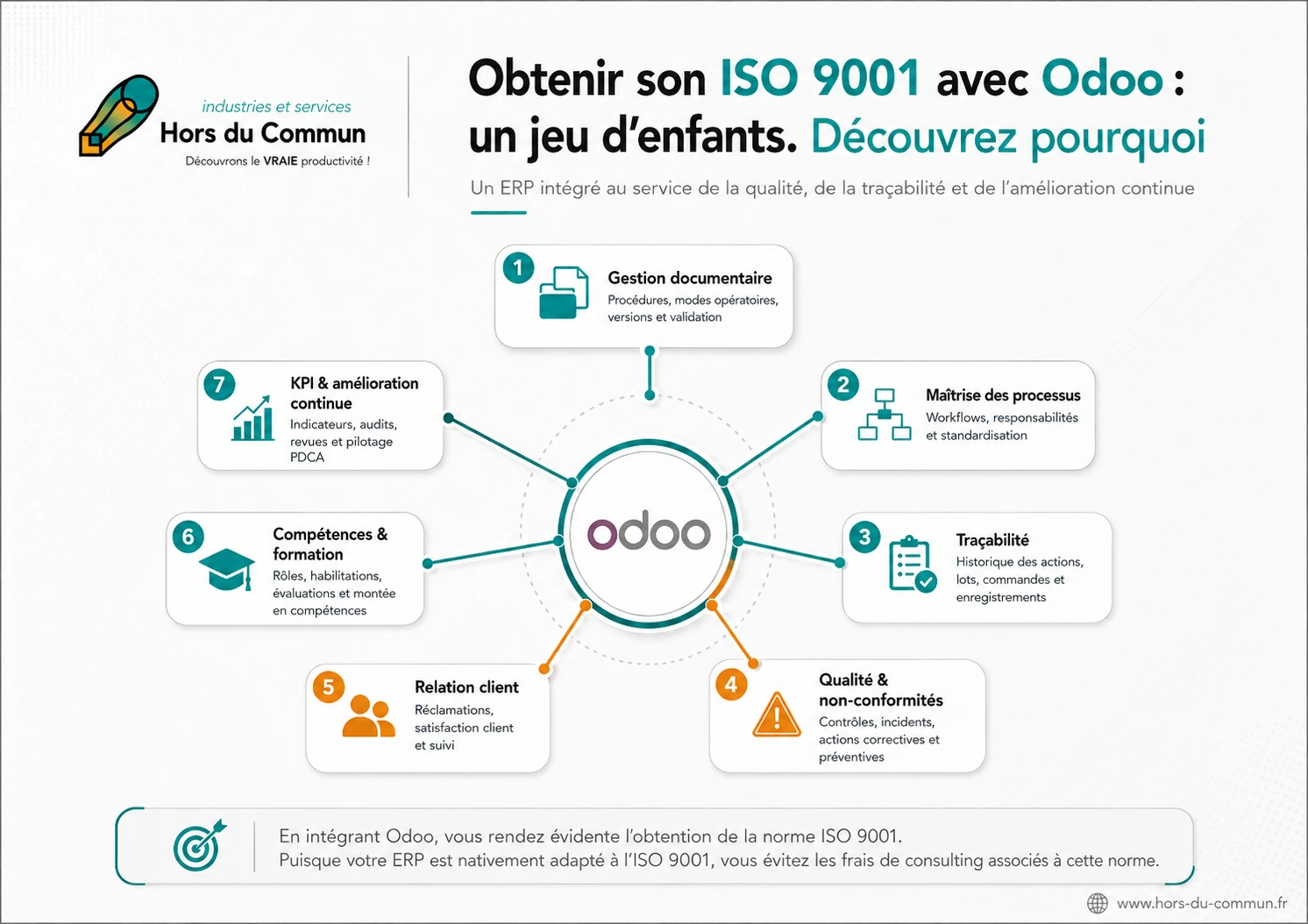
The ISO 9001 standard rests on seven fundamental management principles. Here is exactly how Odoo's standard features turn these theoretical concepts into measurable, auditable and provable actions.
1. Customer focus
The first requirement is to meet and anticipate customer needs. With Odoo, customer feedback no longer gets lost in emails. The Helpdesk app centralizes tickets, applies automatic service level agreements (SLAs) and triggers satisfaction surveys (Surveys) as soon as a request is closed. You show the auditor directly that the voice of the customer is measured.
💡 Productivity tip: To improve your response times and show the auditor your proactive approach, see how to use AI to improve customer support directly from your ERP.
2. Leadership
Management must prove its involvement in the quality system. Management reviews can no longer rely on gut feeling. With the Odoo Dashboards and Spreadsheet apps, business owners access real-time indicators (scrap rate, delivery lead times, financial performance). Quality management reaches the executive committee directly.
3. Engagement of people
A quality approach fails if it remains the quality manager's job alone. In Odoo, engagement is driven by the Chatter (the communication history on every document). Every employee can log a note, tag a colleague or flag a defect directly from a manufacturing order or a vendor receipt. Quality goes back to the shop floor.
4. Process approach
This is the backbone of an ERP. The standard requires you to control the interactions between departments. In Odoo, information flows as one continuous process: quote ➔ order ➔ procurement ➔ manufacturing order ➔ delivery ➔ invoicing. Silos disappear, and each step depends on the success of the previous one.
5. Improvement
Handling nonconformities must lead to progress. The Quality app lets you set up strict control points (measurements, photos, tolerances). If a check fails, the system instantly creates a quality alert. This alert triggers a cause analysis and, if needed, an engineering change order (ECO) managed in the PLM app to fix the problem for good.
6. Evidence-based decision making
ISO 9001 hates improvisation. During an audit, you have to back up your claims. Odoo's very architecture, built on cross-referenced data, lets you trace a problem back to its source. Pivot views and the advanced filter system let you isolate the root cause of a production drift or a drop in margin in seconds.
7. Relationship management with interested parties
The quality of your products depends on your partners. The Purchase app includes ongoing vendor evaluation. You can track precisely the rate of late deliveries or defects at receipt (through Inventory). Odoo lets you objectively justify keeping or removing a subcontractor from your approved panel.

You, on the day of the ISO renewal audit, when you generate the full traceability matrix of a production lot in a single click.
💡 Use case: Upstream and downstream traceability (lot and serial number tracking) is the cornerstone for validating your certifications. See how to model this logistical rigor with Odoo for manufacturing.
Document management and compliance: from theory to evidence
Controlling documented information (required by clause 7 of the ISO standard) is often a nightmare for quality professionals. How do you make sure an operator at a machining center is using version 3.0 of the work instructions and not last year's old laminated sheet? Odoo answers with a powerful trio of apps:
- Odoo PLM (Product Lifecycle Management): it manages engineering change orders. The history of your bills of materials becomes tamper-proof. In the event of a product recall, you immediately identify the exact version of the bill of materials used in production two years ago.
- Odoo Documents & Sign: automatic versioning, restricted access and digital approval make physical signature books obsolete. Odoo Sign provides legally valid acknowledgment that your teams have read a new safety instruction.
- Odoo Knowledge: your quality management manual leaves the static PDF format behind and becomes a living knowledge base, connected directly to product records and work centers.
“By 2026, 70% of organizations will integrate their quality management systems (QMS) directly into their core ERP platforms, reducing nonconformity processing times and speeding up evidence-based decision making.”
Gartner, Insights on Quality Management Systems
Quality certification: what Odoo software will not do for you
No IT tool, however powerful, will ever replace company culture. Odoo makes the QMS visible, smooth and automated. But putting broken business processes into an ERP will only produce a window-dressing certification, fragile and useless.
The software will not define your continuous improvement policy. It will not run your annual internal audits (required by clause 9). And if management does not train its teams on the importance of reporting a defect through the system rather than throwing the part in the scrap bin to save time, the return on investment will be zero. Odoo's real power lies in automating the collection of evidence for the standard, freeing up valuable time for risk analysis and operational management.
💡 Going further: Change management to get your teams on board requires rigorous oversight. See how to structure these cross-functional action plans with projects, timesheets and planning in Odoo.
- ISO 9001 - Quality management (official website): https://www.iso.org/fr/iso-9001-quality-management.html
- Gartner - Quality Management Supply Chain Insights: https://www.gartner.com/en/supply-chain/insights/quality-management

|
Article written by Armand MeotOdoo integrator at Hors du Commun (Lyon). I help manufacturing and service SMEs model their complex processes and roll out their quality systems, to make them certifiable, scalable and profitable. |