Hors du Commun · Our method
Semi-custom Odoo, tailored to your business
A solid Odoo foundation, configured around the way you work. Custom development only where it saves you time. And for every need, a straight question: is it really worth it for you?
The dilemma
Standard or custom? There is a third way
A spreadsheet open next to your software, the same information entered three times, only one person who knows how everything works: if this sounds familiar, this page is for you.
Off the shelf
Standard software
- Quick to get started
- A price known in advance
- You adapt to the tool
- Workarounds everywhere
Our approach
Semi-custom
- A standard foundation, proven by thousands of companies
- Configured around the way you work
- Custom work only where it creates value
Built from scratch
Fully custom development
- Fits your business
- Nothing superfluous
- Slow and expensive
- Fragile the day its developer leaves
The foundation
Three floors, one database
Think of your future software as a building. The secret is in the proportions: a broad, solid foundation, and just the right amount of custom work on top.
- 1The foundation: OdooEverything already exists. Used by millions of people, and improved by the publisher every year.
- 2ConfigurationOdoo set up around the way you operate. Not three boxes to tick: real work, which requires understanding your business.
- 3Custom work, on topFew, but decisive: this is what sets you apart.
Everything in one database
Sales, purchasing, inventory, accounting: data entered once is shared everywhere.
A new version every year
You benefit from the publisher’s progress without redeveloping anything. What’s new in Odoo 20
Built to be extended
What we add plugs in cleanly, without touching the core of the software.
The four filters
Every need goes through four filters, always in the same order
A need only moves down to the next filter if the previous one is not enough. Pick an example: it stops at the right filter.
The vast majority of needs stop at the first filter. When custom development is justified
Profitability
Technically, anything is possible. But is it worth it?
Our role is also to mediate: to check with you that a development will bring you more than it costs. So we always ask you the same question.
“How much time does it take you each month?”
Changing the color of a status
five minutes a month, for the look of it
Over a year: 1 hour
month 1month 12
Cosmetic: a development would never pay for itself. We tell you so, plainly.
Re-keying the website’s orders
twenty hours a month, by hand, every day
Over a year: 240 hours
month 1month 12
More than 34 working days a year: the development pays for itself, often very quickly.
And in your company?
How much time does this task take you?
Every year, this task costs you
60 hours
or 8.6 working days of 7 hours
A few hours a month: a setting or a small development may be enough. Let’s look together at what costs the least.
Review this task with usThe method
Your processes before the tool
Technically, installing Odoo is about ten percent of the work. The rest is below the surface, and that is where the success of the project is decided.
That is why we never start with the tool, but with the way you work.
What this work looks like
Every friction point becomes a concrete goal: not one more feature, a result. It all ends up in a specification, which you review before anything is launched.
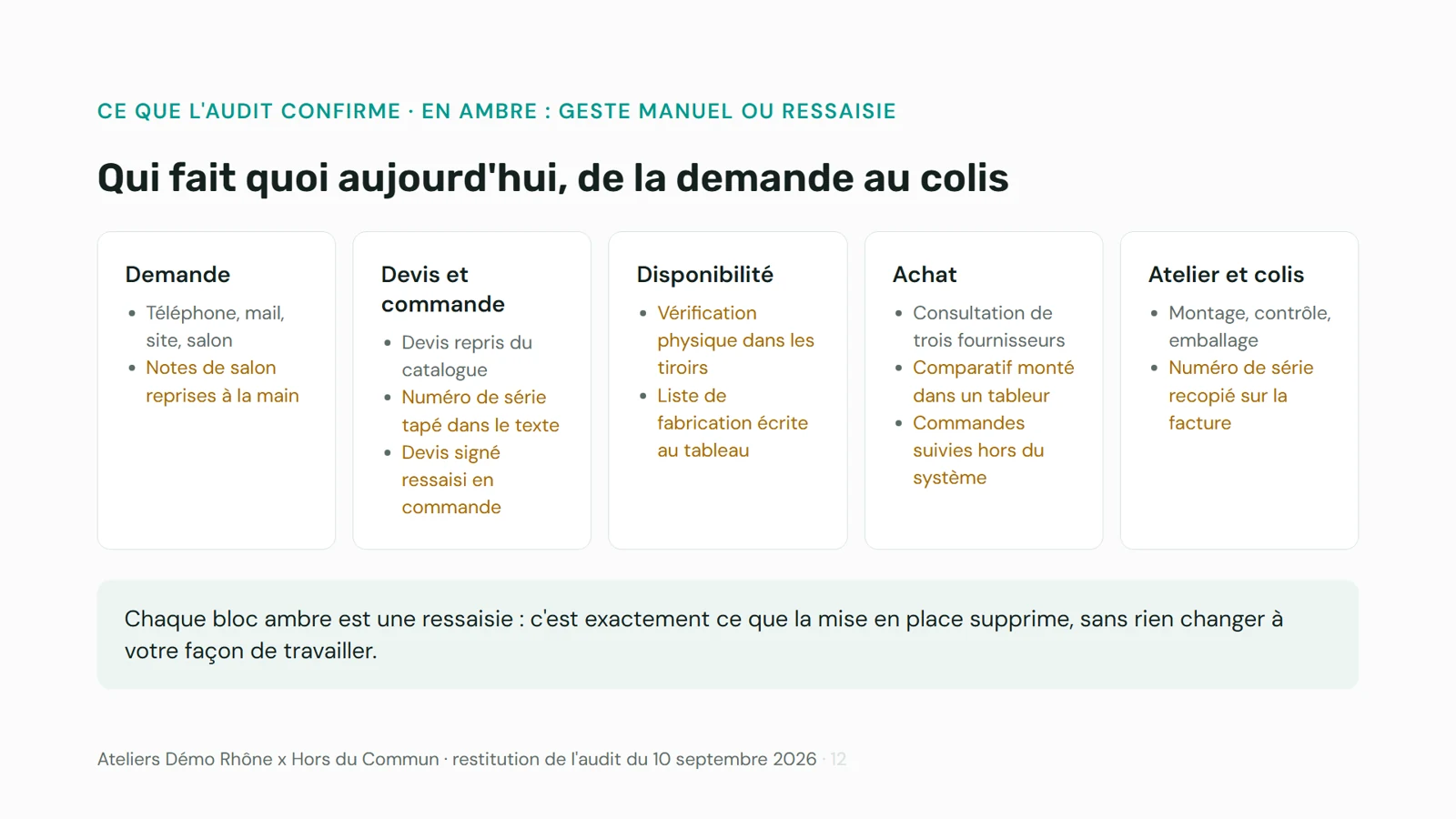 Real example, anonymizedYour process, as it really happensFrom the request to the parcel. In amber: every re-keying, every manual step the implementation will remove.
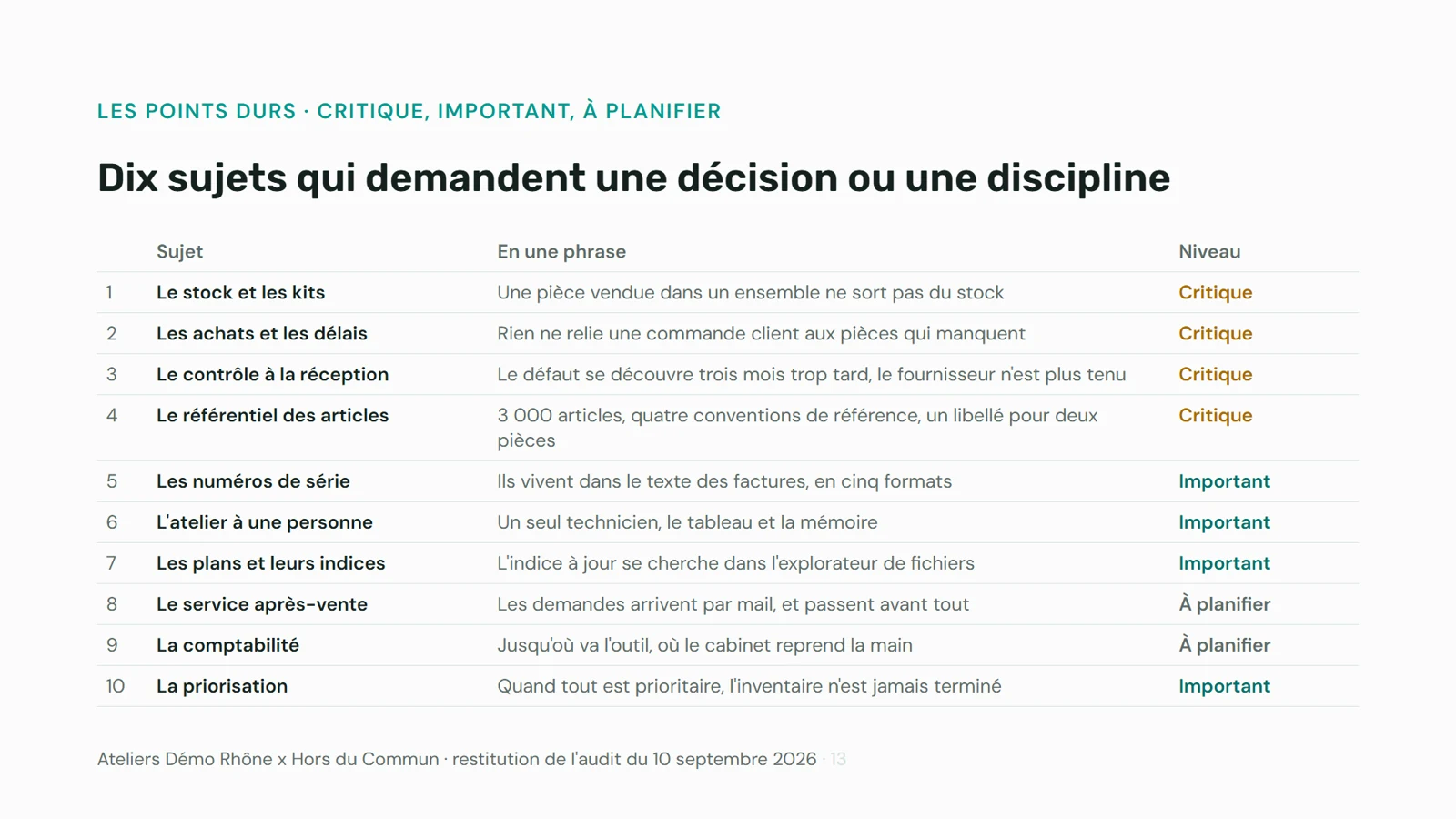 Real example, anonymizedPain points, rankedCritical, important, to schedule: each one calls for a decision, or a discipline.
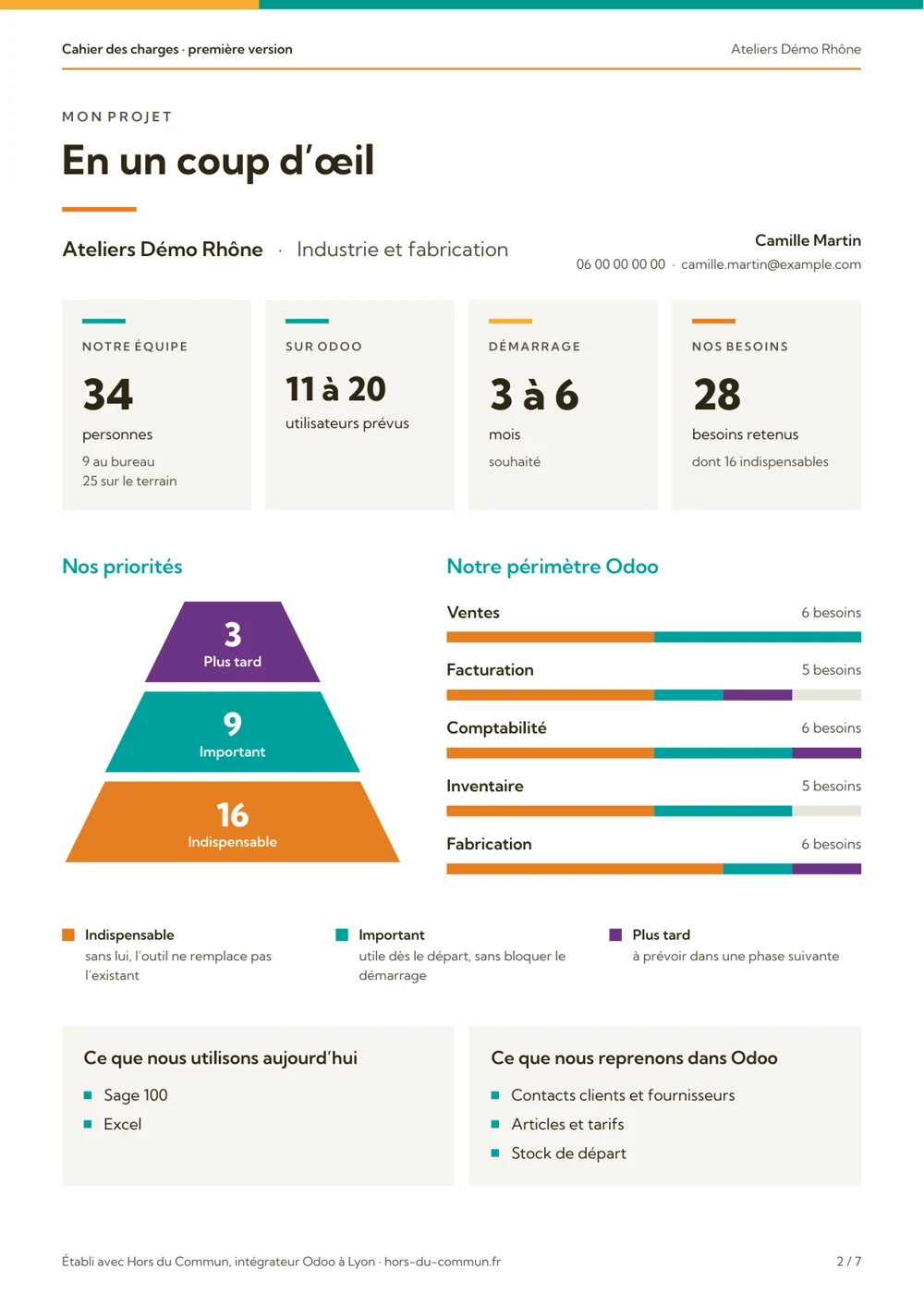 Fictitious exampleThe specificationEach need in one sentence, with its priority, its phase and its price.
Reviewed within 15 days. A line doesn’t suit you? We go over it together.
No guesswork. We never quote a phase we have not analyzed yet.
The document is binding. For the price, for testing, and for go-live.
Short cycles
A wheel that turns every week
Once the priorities are set, the project moves forward in small loops. You see your tool take shape, and you correct it before it is too late.
- 1We buildevery week, in a test database
- 2You testwith your real cases, not with perfect examples
- 3We improvebased on your feedback, and the wheel turns again
Go-live comes afterwards: once a test scenario, a real end-to-end case, runs smoothly on your side. Not before.
A new idea during the project?
It is logged, nothing gets lost. It is quoted separately, and you decide with full knowledge. Then it waits its turn: the current phase is not disrupted, and neither is your go-live date.
Artificial intelligence
AI at every step of your project
We made this choice very early, and we use it every day. The time saved on repetitive tasks, we spend on what matters: your business.
AI decides nothing
Every setting, every line of code is reviewed by a consultant. You see the result before you decide, not after. AI in Odoo, for your teams
What we can do
Three levels of answer, taken from our projects
Real examples, with names and figures changed: from the simplest, showing the right information in the right place, to the feature Odoo does not offer and that we build.
Level 1
The essentials at the top of the record
At an importer of industrial parts, customs information is needed for every order. It was tucked away in a tab.
- Moved to the top of the record, visible at a glance
- Each product is sold in packs: the unit price is calculated automatically
DN50 stainless steel flange
Ref. BR-5021
Sales Price€18.40 per pack
Sales UnitPack of 25
VendorPartner foundry
Fictitious data
Level 2
One file, four locks
A company that finances professional equipment worked with spreadsheets and hand-filled documents. Each step of its files now only opens once all the required documents are in.
- A document is missing: Odoo refuses to go any further
- Documents are generated in one click, then five types of invoices, with no re-keying
- Nobody needs to know the procedure by heart: the tool enforces it
The deal
- Complete customer record
- Supplier quote
- Rent calculated
Summary sent to the customer
The contract
- Identity verified
- Bank details valid
Lease agreementDirect debit mandateFinancing agreement
The delivery
- Equipment delivered
- Acceptance report countersigned
Delivery acceptance report
The assignment
- Signed contract
- Acceptance report
- Supplier invoice
Deed of assignmentWelcome letter
Bank details not valid: the contract cannot be generated.
Fictitious data
Level 3
The eco-fee, line by line
This distributor sells medical equipment subject to France’s eco-fee (éco-participation), whose amount depends on the variant. Odoo did not handle it the way it needed to: we built it.
- One amount per variant, nothing entered by hand
- Under each quote line, and correct in the totals
- The same quote in English, when the customer speaks English
Fauteuil de repos inoxtaille M
41 030,00 €Dont éco-participation mobilier : 4 × 3,20 € = 12,80 €
Matelas prévention escarres90 × 200
101 936,00 €Dont éco-participation mobilier : 10 × 4,60 € = 46,00 €
Table de chevet à rouletteshauteur 80
6589,80 €Dont éco-participation mobilier : 6 × 1,80 € = 10,80 €
Total hors éco-participation3 486,20 €
Éco-participation69,60 €
Total HT3 555,80 €
Fictitious data
Other developments, already running at our clients:
A delivery date per line A blocked product, flagged everywhere All our projectsThe trade-offs
What you gain, what it takes
Semi-custom has its advantages, and its demands. Here they are, honestly.
Every custom development has to keep up with new Odoo versions: this is planned and budgeted. The initial budget is higher than for off-the-shelf software used as is. But over time, the balance clearly tips the right way.
What you gain
What it takes
Configuration first
Custom work remains the exception: less code means less maintenance.
Clean, documented code
Written to Odoo’s standards, and described in your own database.
Designed for new versions
Every development is designed from the start to keep up with Odoo: upgrades are anticipated, not endured.
And once the software is live?
You are not on your own: a dedicated consultant who knows your database, your requests in writing, and no hour counter. Our ongoing Odoo support
Our name
Why “Hors du Commun”?
Three ingredients. Together, they produce complete tools, tailored to businesses that don’t fit in the boxes. That is where our name comes from: “Hors du Commun” means “out of the ordinary”.
Frequently asked questions
What we are often asked
What does “semi-custom” mean?
It is how we implement Odoo: configuration for most of your needs, and custom development only where it saves you time or sets you apart. You keep standard software, which the publisher improves every year, and that still fits the way your business works.
Isn’t configuration enough?
For the vast majority of needs, yes. Every need goes through configuration first, then Studio, then an existing module. Custom development only comes as a last resort: when the need is critical, when it sets you apart, and when it pays back more than it will cost to maintain.
How do you know whether a development is worth it?
We ask you a simple question: how much time does this task take you each month? A few minutes of convenience do not justify a development. Hours of re-keying do: the development pays for itself, often very quickly. We tell you plainly, either way.
What happens to our custom developments with each new Odoo version?
They have to follow, and that is planned from the start: code written to Odoo’s standards, documented in your own database, and upgrades anticipated rather than endured. This adaptation is planned and budgeted. It is also why we keep custom work for what really matters.
How much does a semi-custom project cost?
Everything is written down in a specification: each need, with its priority, its phase and its price. We never quote a phase we have not analyzed yet: the next one is quoted while the previous one is being tested. For a first estimate, see our project price ranges.
We already run Odoo: can you develop it further?
Yes. If your Odoo was set up by another integrator or in-house, we start with a takeover review of your database: what is installed, the quality of your data, what has been developed. Then every change goes through the same four filters.
Does AI replace your consultants?
No. It saves us time to understand, demonstrate, build, test and document. But it decides nothing: every setting and every line of code is reviewed by a consultant.
Let’s talk about your business
Your business doesn’t fit in the boxes?
Tell us how you work. We will tell you plainly what Odoo already does for you, and what is worth a development, or not.
- 1You write to us, including what takes up your time each month if you like.
- 2We discuss it in a first free meeting, 30 to 50 minutes long.
- 3You know what configuration covers, and what a development would bring you.

Billy FelicieOdoo project manager

Armand MéotOdoo implementation consultant
Prefer to call? 04 28 29 14 84
Going further