
In an SME, an Odoo project is managed on three levels: the business owner sponsors it and makes the calls, an internal project manager drives it day to day, and one lead per business area validates each app. The Odoo integrator advises, configures and trains, but cannot lead the project for you, because it decides neither your priorities nor your organization.
The question may seem administrative. It is decisive. An ERP project changes the way the company sells, buys, stores, produces and invoices. Every week, decisions have to be made: keep a discount rule or simplify it, migrate ten years of history or start fresh, go live in January or wait for the end of the season. If no one has the mandate to decide, these questions stay open, the schedule slips and the budget follows. Here is who does what, how to choose the right person and how to organize project management without turning your SME into a meeting factory.
Who really leads an Odoo project in an SME?
In a company with 10 to 50 employees, there is usually no IT director, no project management office and no IT team. Project management therefore rests on people who already have a full-time job. That is precisely why roles must be clear, written down and known to everyone from the kickoff.
Five roles come up in well-run projects. They don't require five different people: in a small company, the same employee can be project manager and lead for their own business area. However, every role must have an owner.
| Role | Who, in an SME | What they do |
|---|---|---|
| Sponsor | The business owner | Gives the mandate, sets priorities, settles disagreements between departments |
| Internal project manager | A cross-functional manager: CFO, administrative manager, sales administration manager or operations manager | Centralizes requests, prepares decisions, keeps the schedule and tests on track |
| Business leads | One person per app: sales, purchasing, inventory, manufacturing, accounting | Describe how work is done on the ground, test the flows, train their colleagues |
| Integrator | The Odoo partner | Analyzes gaps with the standard, configures, advises, trains |
| Accountant | The company's accounting firm | Validates the chart of accounts, taxes and the migration of balances |
The heart of the setup is the pair formed by the business owner and the internal project manager. The business owner decides, the project manager moves things forward. When one of the two is missing, the project runs for a few weeks on the initial enthusiasm, then gets bogged down.
What is the business owner's role in an Odoo project?
The business owner is the project sponsor. They don't need to know Odoo's configuration, or to attend every workshop. Their role comes down to four verbs: mandate, prioritize, decide, lead by example.
- Mandate: announce to the teams who leads the project, and with what authority.
- Prioritize: say clearly that the project comes before certain day-to-day tasks, otherwise emergencies always win.
- Decide: settle disagreements between departments, approve the scope of phase 1, agree to give up certain requests.
- Lead by example: use Odoo's dashboards themselves rather than asking for the old Excel file.
This role is not symbolic. Every year, the Project Management Institute surveys thousands of project professionals (4,455 for the 2018 edition), across all types of projects, not just ERP projects. Its finding on sponsors comes up edition after edition:
“One in four organizations (26%) reports that inadequate sponsor support is the primary cause of their failed projects.” (PMI, Pulse of the Profession 2018)
The same study concludes that the active involvement of an executive sponsor is the top factor that helps a project meet its original goals. An Odoo project is no exception, and in an SME, that sponsor is you.
In practice, the business owner's presence matters most at three moments: the kickoff meeting, where they publicly give the project manager their mandate; steering committee meetings, where decisions that commit the budget are made; and the go-live decision, which cannot be delegated. The rest of the time, they mainly need to stay reachable when a decision is blocking. What management should say at kickoff, the role of the SPoC and the key users, the pace of workshops and the gap analysis: we cover all of this in detail on our page about how an Odoo audit and scoping phase unfolds.
Who should be the internal project manager?
This is the trickiest question, and the one SMEs most often get wrong. The reflex is to hand the project to “the person who is comfortable with computers,” or to the youngest member of the team. That is rarely the right choice. The internal project manager, whom we also call the SPoC (Single Point of Contact, the main contact on the client side), is not a technician: they are a conductor.
Three criteria matter:
- A cross-functional view. They understand how an order moves through the company, from quote to payment, via inventory, the shop floor and invoicing.
- Decision-making power. They can make calls without sending everything back to a committee or to the business owner, and they know how to recognize the questions that need to go up to them.
- Time that is genuinely freed up. This is not a side assignment to squeeze in between two emergencies.
In a manufacturing or trading SME, the profile that ticks these boxes is often the CFO or the administrative and financial manager, the sales administration manager, or the operations manager. In a services company, it is sometimes the partner in charge of management. The business owner can take on this role themselves, on one condition: setting aside the time it requires every week, which few SME owners manage to do over several months.
How much time should you plan for? The pace we follow during the audit and scoping phase gives an order of magnitude: one to two workshops per week, two to four hours each. And for every hour of workshop with us, you often need to plan one to two hours of internal work to prepare, decide or consolidate. If your project manager's schedule is already full, the project will come after everything else. Explicitly take tasks off their plate for the duration of the project, and tell the team.

You when you've been named Odoo project manager “on top of your job” and no one has removed a single line from your job description.
Why appoint a lead for each business area?
The project manager has the big picture. That doesn't mean they know every exception on the ground: the customer who pays at 90 days with an early payment discount, the item sold by the meter and bought by the roll, the urgent order delivered before it is entered. The business leads are the ones who know these details. They are also called key users.
Their role is twofold. During scoping, they describe the actual flows: tools used, re-entry of data, parallel files, friction points. During acceptance testing, they test the scenarios in Odoo with real data and confirm that the flow holds up. After go-live, they become the first line of support for their colleagues.
Involving them early is not a courtesy. A gap discovered during testing costs far more than a gap spotted in a workshop, because configuration that has already been done must then be reworked, or a custom development added. The latest survey by the consulting firm Panorama Consulting on ERP projects points in the same direction:
“More than a quarter of organizations exceeded their project budget, and the need for additional technology is the top cause cited.” (Panorama Consulting Group, press release presenting The 2026 ERP Report)
One of the firm's managers explains it this way: companies often discover late in the project that the tool doesn't fit a requirement, and then compensate with additional tools, a broader scope or custom development. This is exactly what business leads involved from the scoping phase help avoid.
A good business lead is not necessarily the head of the department. It is the person who does the work every day and whom colleagues turn to when they are stuck. Business leads also have a very concrete task before go-live: preparing their data. Extracting, sorting and cleaning customer, item or vendor files takes time, and no one else can do it for them. Which data to migrate, how to rework it and who does what: we cover this work in detail on our page how to migrate your data to Odoo.
What does the integrator do, and not do?
The Odoo integrator brings knowledge of the software and the method. It compares your requirements with standard Odoo and classifies each topic: what Odoo can already do, what is a matter of configuration, what is better handled by an organizational change, and what justifies custom development. It configures, advises, flags risks and trains the teams.
It also manages its own part: its schedule, its deliverables, the quality of its configuration. But it cannot decide your business rules, your priorities or who will do what tomorrow on your behalf. An integrator who leads an ERP project alone ends up configuring what it understands of your company, not what your company is. And when a call has to be made between two departments, it has no legitimacy to make it.
Its most useful role is often to challenge requests. Reproducing the old system's habits exactly is the classic mistake. A good integrator asks three questions for each request: is it really necessary? Is it useful before go-live? Can the same result be achieved another way? The internal project manager and the business owner remain the ones who answer. The levels of customization, from standard to custom development, and the questions to ask before developing are covered on a full page: when to avoid custom development in Odoo.
Finally, the accountant steps in only occasionally, but at specific moments: validating the chart of accounts and taxes, choosing the inventory valuation method, migrating customer and vendor balances at go-live. Let them know at kickoff, not the week of the switchover.
How do you organize the day-to-day management of an Odoo project?
Managing an ERP project in an SME doesn't require a sophisticated tool. It requires three things: a list of actions with an owner and a due date for each, a breakdown into phases, and a regular meeting where decisions get made. If you are moving to Odoo, the Project app does the job very well, and it is a first concrete use of the software for the team.
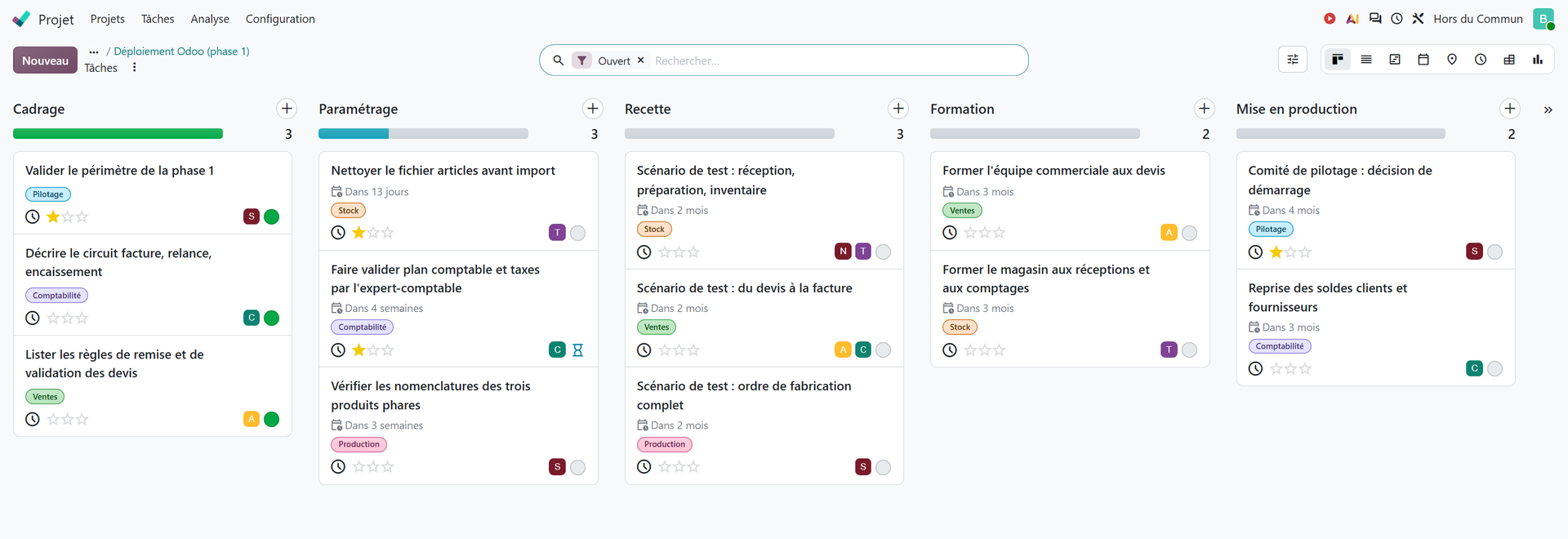
In the fictitious example below, each phase of the project is a stage (scoping, configuration, acceptance testing, training, go-live), and each action is a task assigned to a business lead, with a tag per business area and a due date as long as it remains to be done (the scoping tasks, already validated, no longer show one). The internal project manager can see at a glance what is moving forward and what is waiting.
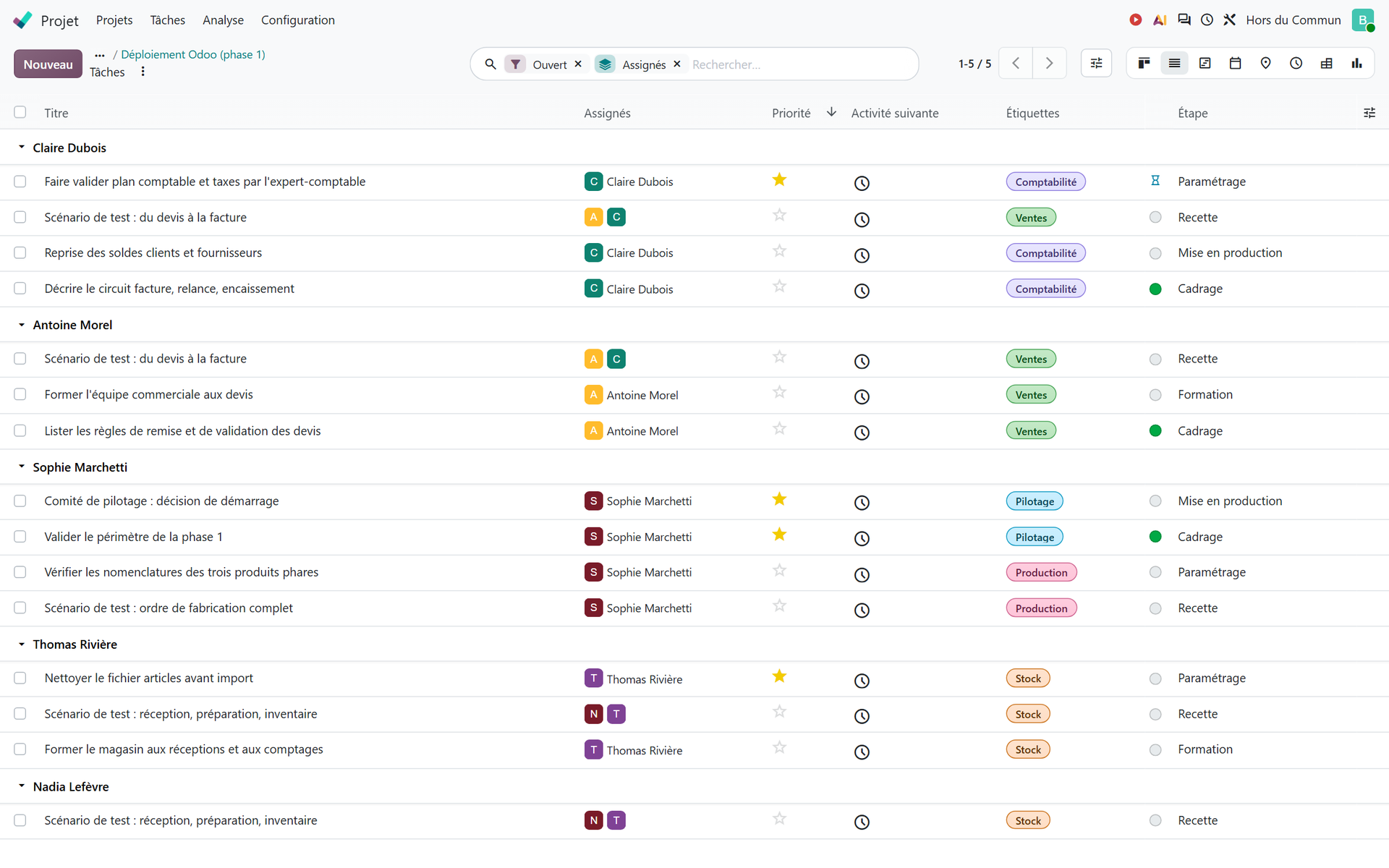
The same list, grouped by person, answers the question the business owner should ask before every committee meeting: who is carrying what, and is the workload realistic? If a business lead is piling up ten tasks during their department's busiest period, now is the time to see it, not three weeks later.
When it comes to rituals, keep it simple:
- A short weekly check-in between the internal project manager and the integrator, to track progress and blocking issues.
- A steering committee at regular intervals, for example every two weeks, with the business owner, to approve the decisions that affect the scope, the budget or the go-live date.
- A single channel for requests. Every request goes through the internal project manager, who consolidates it before passing it on. No more salespeople writing directly to the consultant to add a field.
Splitting the project into short cycles makes this management much simpler: in each cycle, a reduced scope, tests by the business leads, a decision. These cycles, the role of the business lead and business testing are described on our page how to implement Odoo.
Which project management mistakes derail an Odoo project?
From one ERP project to the next, the same governance mistakes come up. None of them is technical.
- Several people giving orders. The sales director, the accountant and the shop floor manager each send their requests to the integrator, who receives conflicting instructions.
- A project manager without a mandate. They prepare everything, but every decision goes up to the business owner, who has no time. Decisions pile up.
- A business owner absent until acceptance testing. They discover the tool once everything is configured, and question choices approved two months earlier.
- Business leads appointed but not freed up. They miss workshops, test at the last minute, and acceptance testing happens in production.
- A project delegated to the integrator. The company expects “turnkey” software and discovers that no one in-house can explain it to the teams.
- No clear phase 1. Everyone wants everything, right away, and the go-live date slips back at every committee meeting.

You when the steering committee lasts two hours and the only person who could make the call sent their apologies by email.
The remedy fits on one page, to be written before the kickoff meeting: the sponsor's name, the internal project manager's name and mandate, one business lead per app, the time freed up for each, the pace of committee meetings and the single channel for requests. This page is worth more than any project management tool.
In short, an Odoo project in an SME is not led by the software, nor by the integrator alone. It is sponsored by the business owner, driven by an internal project manager who has time and a mandate, and validated by business leads who know the ground. At Hors du Commun, an Odoo integrator in Lyon, that is the whole purpose of the kickoff meeting: giving the SPoC their mandate and aligning management, the key users and our team before touching a single Odoo module.
- Project Management Institute (PMI), Pulse of the Profession 2018, “Success in Disruptive Times”: https://www.pmi.org/-/media/pmi/documents/public/pdf/learning/thought-leadership/pulse/pulse-of-the-profession-2018.pdf
- Panorama Consulting Group, press release presenting The 2026 ERP Report, 2026: https://www.panorama-consulting.com/panorama-consulting-group-releases-latest-study-of-erp-implementation-outcomes-across-the-globe/

Article written by Billy Felicie
Odoo integration expert at Hors du Commun (Lyon). I have been helping SMEs implement their digital tools and optimize their business processes for more than 5 years.