
An SME should switch to an ERP when its separate tools cost it more, in re-entry, errors and decisions made blind, than a single management system would. In practice, that moment comes when several lasting signals pile up (double entry, margin or stock impossible to find without rebuilding a spreadsheet) and an upcoming event, such as a new hire, a new site or e-invoicing, is about to multiply them, provided your business rules are stable enough to be written down.
Company size matters less than people think. A company of eight people can need one before another of forty. What decides is the complexity of your flows and the price you pay every week to hold them together.
We are an Odoo integrator in Lyon: the screens illustrating this article come from Odoo 20, but the decision grid applies to any ERP.
What is the right time to switch to an ERP?
An ERP (enterprise resource planning software) brings sales, purchasing, inventory, production, invoicing and accounting together in a single database. Information entered once is used everywhere: the order becomes a delivery, the delivery becomes an invoice, the invoice becomes an accounting entry.
Before the ERP, each department has its own tool: the salesperson's spreadsheet, the sales administration team's quoting software, the warehouse spreadsheet. At first, it works. Then the company grows, and the cost of fragmentation rises without anyone seeing it, because it is spread across everyone:
- time spent re-entering data, a little every day, in every department;
- invoicing errors, discovered by the customer;
- stockouts or, the other way around, stock sitting idle;
- forgotten payment reminders, and therefore cash that waits;
- a business owner who consolidates the numbers at night instead of steering the company.
On the other side, the cost of change is known: licenses, configuration, data migration and a few weeks of effort from the teams. The right time is when the first cost exceeds the second, often well before the business owner realizes it.
The difference shows on a single order. In an ERP, the salesperson does not need to tell anyone: the confirmed order creates the delivery, the warehouse validates it, the invoice goes out from the same record, and everyone reads in the same place what has been delivered and what has been invoiced.
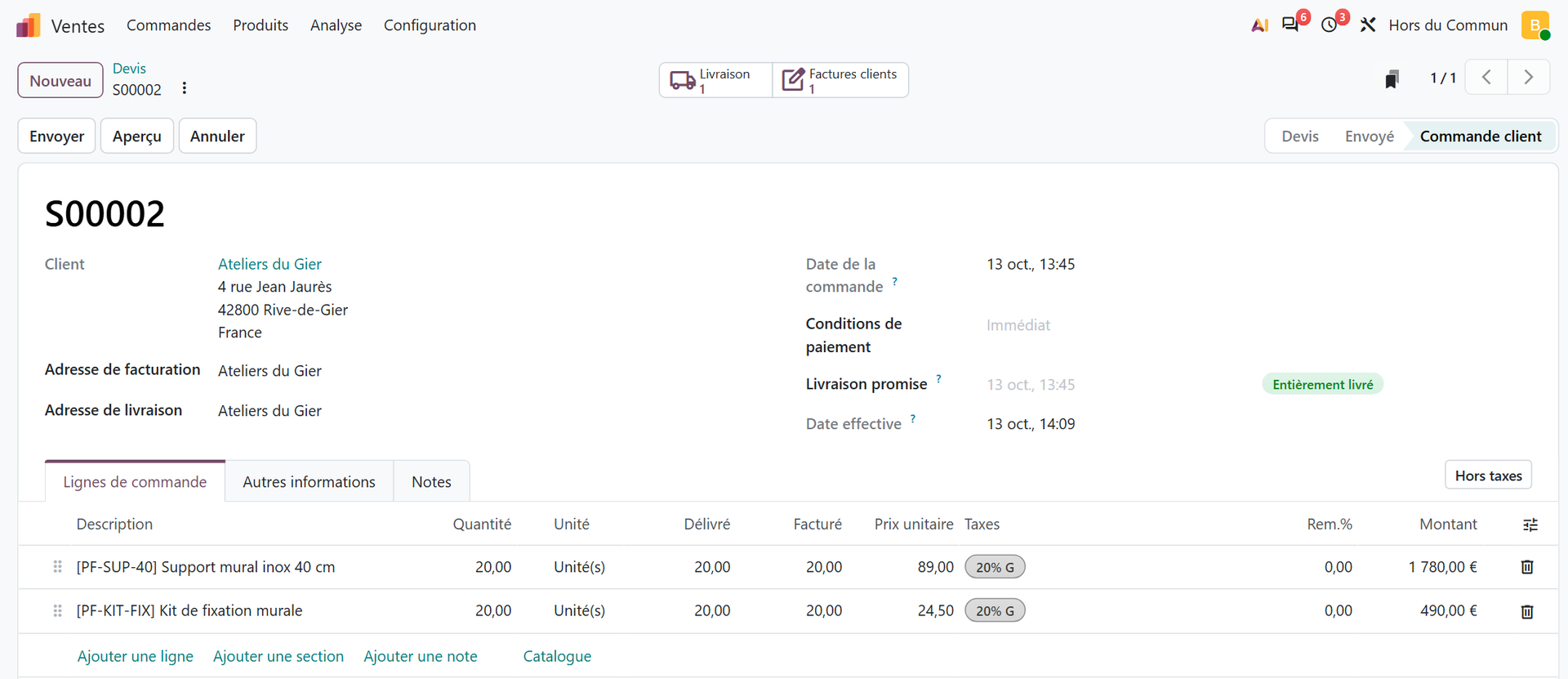
And ERP is no longer reserved for large groups:
“In 2025, the percentage of EU enterprises using Enterprise Resource Planning (ERP) software ranged from 41.08% for small enterprises to 88.71% for large enterprises.” Small enterprises here means 10 to 49 employees. (Eurostat, Statistics Explained, “E-business integration”, 2026)
Four out of ten small European companies already work with an ERP. Some of your competitors probably process an order with fewer manual steps than you do.
Which signals show that your tools are no longer enough?
The symptoms are almost always the same. Honestly check what happens in your company every week, not once a year.
- Double entry has become a job in itself: the order is typed into the sales spreadsheet, typed again into invoicing, then a third time in accounting.
- The stock shown is never right. Before promising a lead time, someone calls the warehouse or goes to count.
- Nobody knows the margin per deal or per product before the annual closing.
- The business owner rebuilds the numbers at night, cross-checking three exports in a spreadsheet.
- Only one person understands the spreadsheet that runs the company. When they are away, everything slows down.
- Customer payment reminders depend on someone's memory, and late payments grow longer without anyone knowing by how much.
- The online store, the CRM and the bank each have their own version of the truth: people spend their time exporting and pasting.
- A simple customer question (“Where is my order?”, “Which lot does this part come from?”) ties up three people for half a day.

You when you retype the same order for the third time today: quote, invoice, then accounting.
A single signal can often be fixed without changing tools. From two lasting signals on, and as soon as an upcoming event is about to multiply them, the question is no longer whether you need an ERP, but when the project starts. One prerequisite remains: business rules stable enough to be written down.
What remains is knowing which ones really weigh on your company, and how much they cost. That is the purpose of a diagnosis of your real flows, carried out before choosing any tool; we detail how it works on this page: how an Odoo audit works.
Should you wait until you reach a certain size?
No. Headcount says nothing about the complexity of operations. An eight-person trading company that manages thousands of SKUs, imports its purchases and sells online needs an ERP more than a thirty-person consulting firm that bills a few fixed-price assignments. What counts is the complexity of your flows, and these six criteria measure it better than headcount:
| Criterion | Separate tools still hold up | The ERP becomes necessary |
|---|---|---|
| Inventory | No stock, or a few items | Many SKUs, several locations, lots or serial numbers |
| Production | None, or simple assembly | Bills of materials, manufacturing orders, quality control |
| Invoicing | Few invoices, all simple | Down payments, time-based invoicing, milestones, several currencies |
| Organization | The business owner and two or three people | Several departments handing over each order to one another |
| Tools | One or two software tools | Four or more tools, linked by manual exports |
| Management reporting | One review a year with the accountant is enough | Need to track margin, stock and cash every week |
The most underestimated criterion is the last one: the day a bank or a partner asks for a reliable figure per business line, the gap becomes visible all at once.
If you manufacture, the question often comes up earlier, because production links inventory, purchasing and the lead times promised to customers. We describe what the ERP then takes over, from bills of materials to quality control, on our page Odoo for manufacturing.
Can you switch to an ERP too early?
Yes. An ERP sets business rules in stone: who approves what, how a price is calculated, when you invoice. If these rules change every month, the tool becomes a constraint instead of a support. Four situations justify waiting:
- your offer is not settled: you are still testing your prices and sales channels, and good invoicing software is enough for now;
- nobody can carry the project internally, whereas you need a business lead who has time to decide, test and train;
- a sale or a merger is imminent, and the future shareholder may already have its own tool;
- the problem is not the software: if orders get lost because nobody is responsible for sales administration, an ERP will change nothing.
That said, the opposite risk is far more common: waiting too long. Each extra year piles up spreadsheets, habits and exceptions. Data migration gets heavier, and the project ends up starting in a rush, at the worst possible time.

You when you postpone the ERP project “until next year”, for the fourth year in a row.
And it is precisely when needs are discovered too late that budgets slip:
“The report also revealed that more than a quarter of organizations exceeded their project budgets, with additional technology needs cited as the leading cause.” These additional needs were discovered along the way, during the ERP project. (Panorama Consulting Group, The 2026 ERP Report, 2026)
A project started in calm conditions, with time to map its flows, discovers its needs at the beginning. A project started in a panic discovers them halfway through, when every change is expensive.
Which events should trigger the decision?
Some events leave no choice on timing, because they multiply the volume or complexity of flows. The ERP must be in place before, not during.
Mandatory e-invoicing
Since September 1, 2026, all companies subject to VAT in France must be able to receive electronic invoices. SMEs and micro-businesses will have to issue them from September 1, 2027, through an approved platform (PA, France's certified e-invoicing platform). If your invoices come out of a spreadsheet or a tool that does not handle these exchanges, you will have to change anyway: you might as well change only once, covering the whole chain from quote to payment.
A hire that changes the organization
The second salesperson, the first sales administration manager, the first warehouse clerk: what used to fit in the business owner's head must now fit in a shared tool.
A new site or end-of-life software
Opening a warehouse, a workshop or an online store means multiplying the places where stock can be wrong. And if your current software is no longer maintained, you will migrate anyway: you might as well widen the scope rather than rebuild the same stack.
A takeover, an investor, a customer requirement
A business takeover, a new partner coming in, a bank asking for monthly reporting, a key account requiring lot traceability: all of them ask for figures that separate tools produce poorly.
Where should you start when switching to an ERP?
The rule: a narrow scope, the standard first, short waves. Trying to cover everything on day one is the surest way never to get started.
1. Map three flows, not thirty
Draw the flows that keep the company running: from quote to payment, from purchase to receipt, and from order to production if you manufacture. For each step, note who enters what, in which tool, and where information gets lost.
2. Choose a useful first scope
Start with what brings in money and what hurts the most. For a trading SME, that is often Sales, Purchase, Inventory and Invoicing. For a services company, Sales, Project, Timesheets and Invoicing. Manufacturing, human resources or the online store come in a second wave.
3. Use the standard before developing
A modern ERP covers the essentials through configuration. Take replenishment, which often lives in a spreadsheet kept by a single person. In Odoo, each stocked product can have a replenishment rule, with a minimum and a maximum stock. The Replenishment screen of the Inventory app compares these thresholds with forecasted stock and calculates the quantity to order, to buy or to manufacture depending on the product.
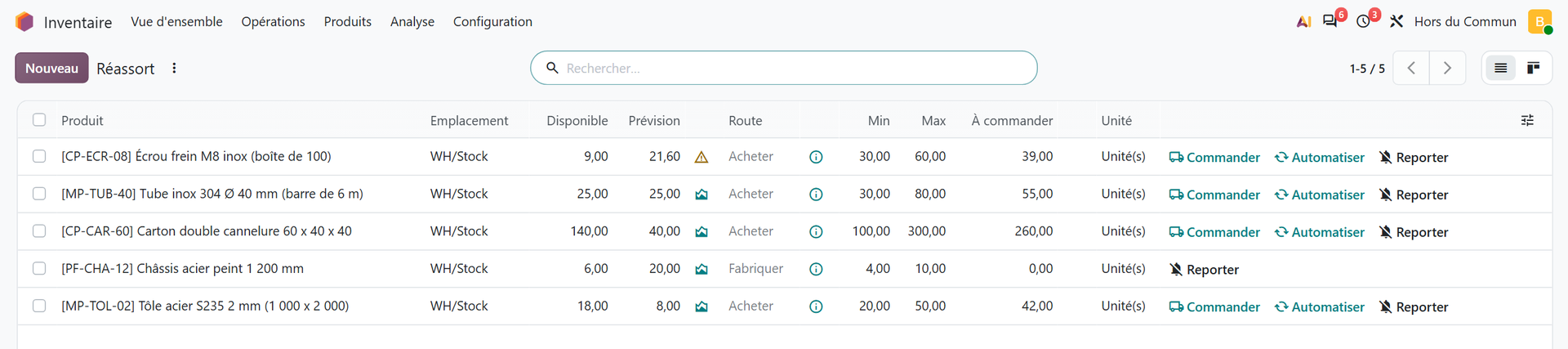
On this screen, a rule set to automatic trigger creates the request for quotation or the manufacturing order by itself when the threshold is crossed. The rest follows the same logic: bank synchronization, online quote signature, invoicing of hours entered in timesheets. Custom development comes next, only if the business gain is clear and lasting, because every line of code added will have to be reworked at each version upgrade.
4. Migrate little data, but clean data
Customers, vendors, products, balances and ongoing deals are enough. History remains available in an archive: a clean database is better than a complete but questionable one.
5. Train, measure, then expand
Train each team on its own screens, track a few simple indicators (time between quote and invoice, late payments), then open the next wave. This split into short waves is what avoids the tunnel effect; we detail the method, from scoping to go-live, on this page: how to run an Odoo implementation.
What budget should you plan for a first ERP?
A first ERP is budgeted in four items. Forget one, and you underestimate the project.
- Licenses. For Odoo, prices are public: as checked on September 27, 2026, the Standard plan is listed at €19.90, then €24.90 per user per month on an annual commitment, and the Custom plan at €35.90, then €44.90. Installing Studio or adding a company moves you to the Custom plan. AI features consume credits purchased separately, and an employee listed in the Employees app without a user account is now billed (a Light User license at €7.90 is available).
- Implementation: scoping, configuration, data migration, testing and training. This is the item that varies the most, depending on the scope and the quality of your starting data.
- Your teams' time: the internal lead, testing, training. This time appears on no invoice, but it determines success.
- Ongoing support after go-live. An ERP lives on after it starts, and this item should be planned in the initial budget.
Also do the reverse calculation: the hours lost every week on re-entry, multiplied by the fully loaded hourly cost and by the number of weeks worked, plus invoicing errors and idle stock. That figure is the real price of waiting.
To build this budget item by item and identify the funding you can mobilize, we invite you to read our page on the cost and funding of an Odoo implementation for SMEs.
How do you know if it is the right time for your SME?
Answer these five questions, without trying to reassure yourself:
- Is the same piece of information (customer, order, product) entered in at least two different tools?
- Does it take more than an hour to find the margin on a deal or the real stock of a product?
- Could one departure or absence block invoicing or purchasing?
- Is a triggering event (e-invoicing, a new hire, a new site, end-of-life software) coming in the next eighteen months?
- Are your offer and your business rules stable enough to be written down?
Two “yes” answers among the first three questions, plus a “yes” to the fourth and the fifth: the time has come to scope the project. Not to sign tomorrow, but to map your flows, define a first scope and put a figure on what fragmentation and change cost.
If the fifth is a “no”, start there: write down your rules and name one owner per flow. This work makes the difference between a controlled project and one that never ends.
Our conviction as an integrator: the right time to switch to an ERP is usually a little before the moment you feel forced to. Early enough to choose your timing, late enough to know precisely what you need.
- Eurostat, Statistics Explained, “E-business integration”, 2026: https://ec.europa.eu/eurostat/statistics-explained/index.php?title=E-business_integration
- Panorama Consulting Group, press release presenting The 2026 ERP Report, 2026: https://www.panorama-consulting.com/panorama-consulting-group-releases-latest-study-of-erp-implementation-outcomes-across-the-globe/

Article written by Billy Felicie
Odoo integration expert at Hors du Commun (Lyon). I have been helping SMEs implement their digital tools and optimize their business processes for more than 5 years.