
To fund an Odoo project, an SME usually combines a loan (Bpifrance, the French public investment bank, offers the Prêt Boost Transformation numérique, from €5,000 to €100,000, to companies with up to 49 employees) and having its training covered by its OPCO (French training funding body). A grant that would pay for the integration itself remains the exception: the regional schemes reviewed for this article fund consulting or take the form of a loan, and the project must be able to go ahead without them.
So the right question is not “which aid should I choose?”, but “which lever for which part of the budget?”. Configuration, data migration, training, annual subscription: each lever covers only part of it. All the conditions cited below were checked on the official pages on October 17, 2026; they change, so check them when you apply.
Loan, OPCO or grant: which lever funds which part of an Odoo project?
Before looking for funding, you need to break down the budget. An integration project is made up of four blocks, which have neither the same timeline nor the same funders.
| Project item | Type | Best-suited lever |
|---|---|---|
| Scoping, configuration, data migration | Upfront investment | Bpifrance or bank loan, self-financing |
| User training | Skills development | OPCO, depending on your industry |
| Odoo subscription | Recurring expense | Operating budget |
| Upstream assessment and consulting | Study | Regional aid for consulting |
This table avoids a classic mistake: looking for a grant to pay for configuration, when none of the schemes reviewed here subsidizes it. Configuration is funded by a loan or from cash flow. Training has its own channel. And the subscription is not financed: it is budgeted, like rent.
You still need to estimate the overall budget and know the pitfalls that make the bill drift, such as migrating ten years of history or unjustified custom development. Our dedicated page gives a range as a percentage of revenue and details these pitfalls; we invite you to read it here: the cost and funding options of an Odoo implementation for SMEs.
What does Bpifrance's Prêt Boost Transformation numérique fund?
It is the most direct lever for an SME with fewer than 50 employees. Bpifrance distributes it online, on its Bpifrance Flash platform, and presents it this way:
“Bpifrance supports companies with up to 49 employees with the Prêt Boost - Transformation numérique (digital transformation loan). Fast credit, 100% online.” (Bpifrance Flash, Prêt Boost - Transformation numérique page, accessed on October 17, 2026)
Among the uses cited by Bpifrance are implementing business management solutions, digitizing documents and training the team on digital tools. An ERP like Odoo therefore falls within the scope. The characteristics displayed on the page:
- Amount: from €5,000 to €100,000.
- Term: adjustable from 3 to 5 years, with a repayment deferral of up to 12 months.
- Collateral: no guarantee required.
- Eligibility: company created more than 3 years ago, up to 49 employees on a consolidated headcount basis, with no insolvency proceedings in progress. Sole proprietorships are not eligible.
- Mandatory borrower insurance covering death and total permanent disability (PTIA) at 100%.
- Fixed rate: “from 6.07%” on the date the page was accessed.
Two conditions do not appear in this table, but in the FAQ of the same platform. First, the company must be supported by an accountant, who provides a certificate. Second, Bpifrance asks for proof of an existing bank loan with more than 3 years of repayment remaining: these loans come on top of bank financing, not instead of it. A company without a bank loan of this kind therefore does not meet the condition.
Bpifrance Flash also offers, on the same model and with the same amounts, a Prêt Boost Facturation électronique (e-invoicing loan) and a Prêt Boost Intelligence artificielle (artificial intelligence loan). If your Odoo project is driven first by the French e-invoicing reform, the former better describes the purpose of the application. Whether two of these loans can be combined needs to be confirmed by Bpifrance.
Take a fictitious 25-employee trading SME, created fifteen years ago, supported by an accountant, with a loan on its warehouse that still has more than three years to repay: it ticks the boxes displayed. Created two years ago, or without a bank loan, it does not. The deferral, for its part, lets you align the first repayments with the go-live.
How do you track the loan in Odoo once it has been granted?
Once the loan is signed, you might as well track it in the tool it helped fund. Odoo has loan management in the Accounting app, via Accounting › Accounting › Loans. You create the loan, then get the amortization schedule in one of three ways: by uploading the file provided by the bank (“Upload” button), by calculating it with the “Compute” button (loan amount, interest rate, period, start date), or by entering the lines manually.
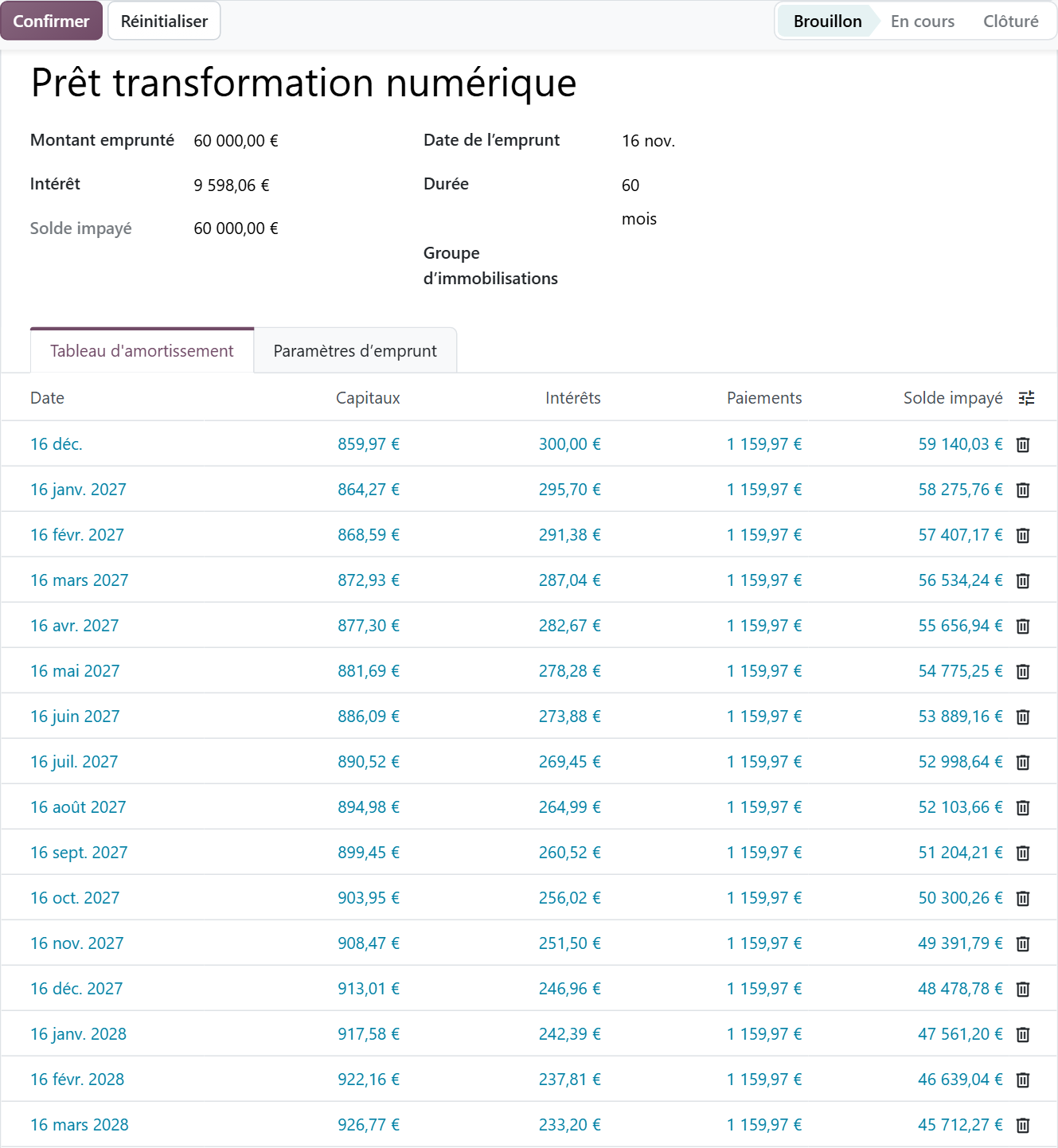
In this fictitious example, entered in a test database at a 6% rate, each monthly payment of €1,159.97 is split between principal and interest, and the outstanding balance goes down line after line. According to the Odoo documentation, confirming the loan creates the entries for each installment, and an automatic reclassification moves the principal due within the next twelve months to short term. The accounts used are configured in the “Loan Settings” tab.
The Accounting › Reporting › Loans Analysis report then gives the view a business owner wants: how much principal, how much interest, year by year.
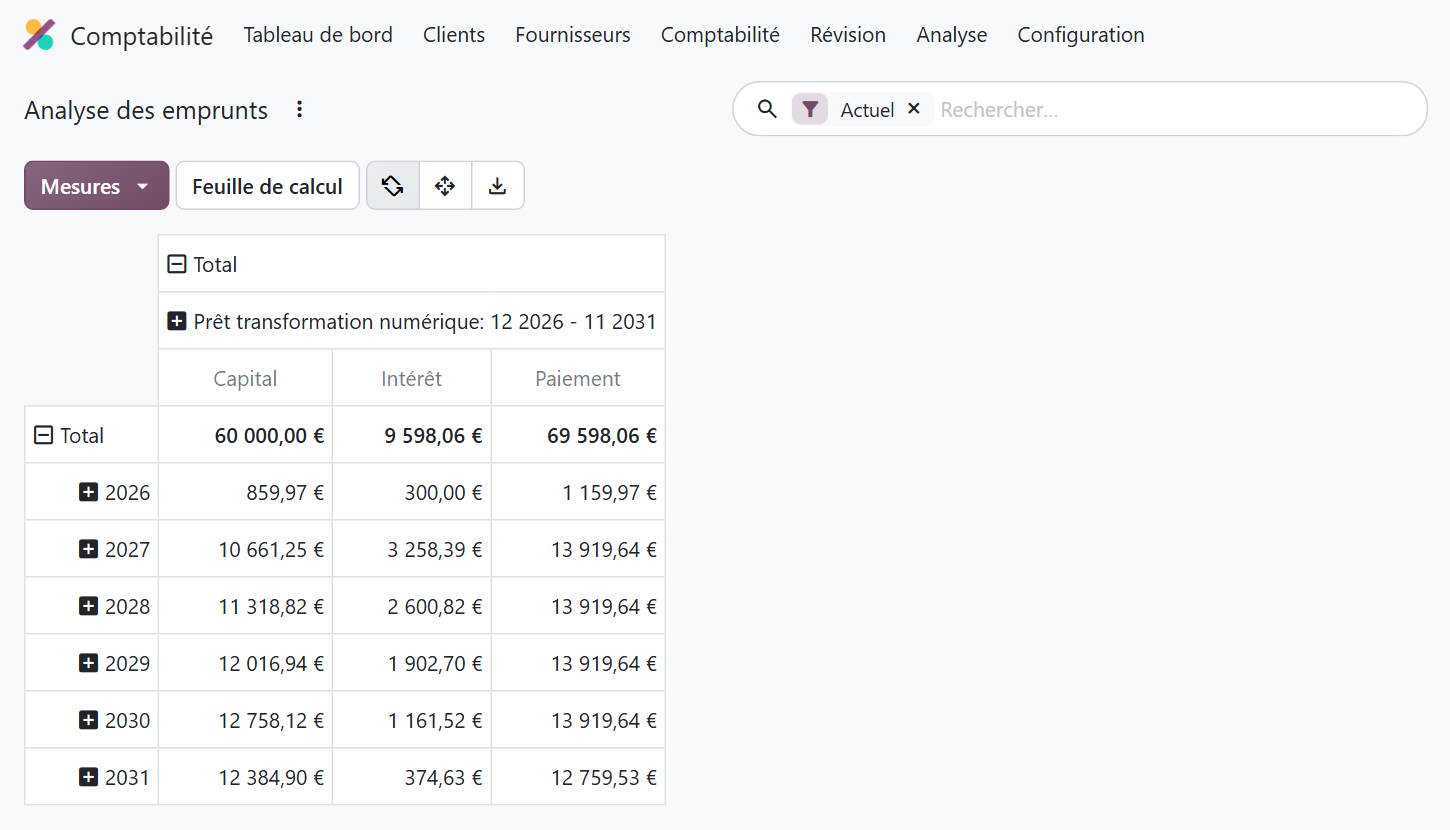
This table feeds directly into the cash flow forecast: you can see at a glance what the project will cost in repayments each year, to be set against the expected gains.
Can the OPCO cover Odoo training?
Yes, under certain conditions. An Odoo project involves a significant share of knowledge transfer: training key users, then the teams. The French Ministry of the Economy points this out:
“OPCOs directly fund companies' training projects, including those with fewer than 50 employees, by supporting skills development on strategic needs (digital, management, specific trades).” (economie.gouv.fr, “Business owners: you can get training too”, 2025)
The ministry encourages you to contact the OPCO for your industry to find out how costs are covered. Conditions vary from one OPCO to another: call your advisor before signing the quote, not after the training.
Training costs for the sessions that accompany the project may be covered by your OPCO, under the Qualiopi framework. To submit the request, it is best if the training can be identified in the quote: a program, a duration, participants, separate from configuration. Training buried in an overall package is hard to present to the OPCO.

You when the OPCO agrees to cover your key users' training and you have finally isolated the line in the quote.
And the business owner? The tax credit for business owner training has no longer existed since December 31, 2024, as the same ministry page confirms, adding that OPCOs can also support the training of business owners. A self-employed business owner falls under a training insurance fund instead: Agefice for self-employed owners in retail, industry and services.
The training schedule matters as much as its funding. In our guide, the project moves forward in short cycles and key users are trained in regular sessions during the implementation, not just the day before go-live: how to carry out an Odoo implementation.
Are there grants for an Odoo project in Auvergne-Rhône-Alpes?
There are, but they rarely fund what you might think. Two schemes checked on the official pages are relevant to an SME in the region preparing an Odoo project.
Atouts Numériques: free consulting, not the integration
On the Campus Région du numérique website, the Auvergne-Rhône-Alpes Region presents Atouts Numériques as free support, 100% funded by the Region and the European Union (ERDF), delivered by the ENE association (Experts du Numérique en Entreprise). It targets companies with fewer than 50 employees and at least two years of activity. Two formats: 3.5 hours of one-on-one meetings, or 7 hours of one-on-one meetings plus 3.5 hours of group training, for example to build a specification. Sales management and inventory management are among the topics covered. It is useful upstream, to clarify the need. It pays neither the integrator nor the subscription.
The Prêt Région Souveraineté Industrielle: a loan, not a grant
For industrial companies, the Region and Bpifrance offer on Bpifrance Flash the Prêt Région Souveraineté Industrielle (regional industrial sovereignty loan): from €10,000 to €75,000, for companies with up to 249 employees, repayable over 5 or 7 years with a deferral of 12 or 24 months, with no personal guarantee, at a preferential fixed rate. Among its uses, Bpifrance cites developing production software and training in new technologies. As with the Boost loan, you need an existing bank loan of more than 3 years. If you are a manufacturer, our page Odoo for manufacturing details what the project covers: bills of materials and manufacturing orders, requirements planning, logistics, quality control and lot traceability.
Then there is the timing trap. An aid application has to be put together, reviewed and approved, and that takes months. Some aid does not fund an expense that has already been committed: check this point before signing anything.

You when you froze your Odoo project while waiting for an answer on the grant application, and your old software just crashed again.
Our position is simple: aid is a bonus, never a condition. An ERP remains an investment the company must be able to afford without it.
Leasing or financial rental: is it a good fit for an Odoo project?
The French Ministry of the Economy describes leasing as a financing method for using, or possibly buying, equipment: a leasing company buys the asset and rents it to you, and at the end of the contract you can keep renting it, return it or buy it. The ministry also specifies that in the event of compulsory liquidation, the lessor can demand the return of the assets.
The key word is “equipment”. Leasing makes sense for the hardware that goes with the project: workstations, barcode scanners for the warehouse, label printers. Much less for the rest: the Odoo subscription is already a periodic expense, and configuration and training are services, not assets a lessor could take back. Some financial rental companies offer packages that include services: have your accountant read the contract, especially regarding the commitment period.
Can you depreciate an Odoo project?
It is an accounting and tax question, not an integration question, and the answer depends on your situation. Still, here are three reference points.
- The Odoo subscription is a recurring expense, paid every year as long as you use the tool.
- How implementation costs are treated, as expenses or as a fixed asset depreciated over several financial years, is decided with your accountant, based on the nature of each item in the quote.
- The exceptional twelve-month depreciation of acquired software was repealed by the 2017 Finance Act: according to the BOFiP (the French tax administration's official guidance), it now only applies to software acquired during financial years beginning on or before December 31, 2016. Do not build your financing plan on it.
In what order should you build the financing plan for an Odoo project?
The order matters more than the schemes themselves. Here is the one that avoids unpleasant surprises.
- Scope the need. Without a written scope, neither the quote nor the loan application rests on solid ground.
- Get an itemized quote: configuration, data migration, training, subscription, each on its own line.
- Ask the OPCO about the training portion, before signing.
- Meet with your accountant: certificate for Bpifrance, accounting treatment of expenses, forecast.
- Submit the loan application, with a deferral aligned with the go-live date.
- Launch the project without waiting for an uncertain grant, and treat it as a bonus if it comes.
The first step determines all the others. Our free questionnaire produces, in about ten minutes, a first specification as a PDF, with your needs ranked by priority, to share with your team and your accountant. We invite you to try it here: the Quick specification builder for Odoo.
In short, an Odoo project is rarely funded by a single lever: the loan for the upfront investment, the OPCO for training, cash flow for the subscription, and aid as a complement. At Hors du Commun, an Odoo integrator in Lyon, we work mainly with SMEs of 10 to 50 users, and we first look for the efforts that solve most of the problems: that is also what makes the project fundable.
- Bpifrance Flash, Prêt Boost - Transformation numérique, characteristics and eligibility (accessed on October 17, 2026): https://flash.bpifrance.fr/financement/pret-boost-transformation-numerique
- French Ministry of the Economy, “Business owners: you can get training too”, 2025: https://www.economie.gouv.fr/entreprises/trouver-des-aides-et-des-financements/les-aides-et-financements-pour-developper-son-7

Article written by Billy Felicie
Odoo integration expert at Hors du Commun (Lyon). I have been helping SMEs implement their digital tools and optimize their business processes for more than 5 years.