
Odoo integrator in Lyon: how do you choose a partner without getting it wrong?
When a company looks for an Odoo integrator in Lyon, it often thinks it is looking for a simple "IT service provider".
In reality, it is mainly looking for someone it can trust with an extremely sensitive subject: its organization, its data, its sales flows, and sometimes even its inventory, its invoicing or its accounting. And that is precisely why the choice is so hard.
Because, at the end of the day, an Odoo integrator is very hard to compare objectively. On paper, everyone can tell roughly the same story:
- We support SMEs.
- We deploy Odoo.
- We build tailor-made solutions.
- We train teams.
- We structure processes.
Fine. But when you are not an ERP implementation expert yourself, how can you tell what service providers are really worth compared to one another?
The problem: integrators are hard to compare
It is a bit like taking your car to the garage.

If you know nothing about mechanics, you cannot really tell:
- Whether the diagnosis was right.
- Whether this or that part really needed replacing.
- Whether the job took 1 hour, 5 hours or 2 days.
- Or even whether the price you paid really matched the work done.
You can look at the invoice, compare two or three quotes, ask around. But deep down, most of the time, you move forward with a certain level of uncertainty.
An ERP project is exactly the same. When a company receives a proposal, it cannot always tell whether the scoping is right, whether the scope is too broad, whether the partner is pushing to do too much custom development, or, on the contrary, whether it is simplifying wisely.
"And that is normal. It is not the business owner's job to know that."
The relationship of trust is often what makes the difference
In real life, you do not choose a mechanic just because they have the nicest quote. You often give them a first job. Then you look: did they understand the problem? Were they honest? Does the car run better afterwards?
With an integrator, the logic is the same. You can hold meetings and read polished sales proposals. But at some point, what really matters is the concrete experience of working together:
- The quality of the conversations.
- The accuracy of the initialOdoo audit .
- The ability to prioritize what is urgent.
- Transparency and keeping commitments.
- The feeling that the provider is really protecting your budget instead of spending it blindly.
Our strategy: split the project, start small, let the client judge
For all these reasons, at Hors du Commun, we avoid pushing huge projects right away, sold as closed blocks of €100,000 or €200,000.
Not because large projects do not exist. But because asking an SME to commit immediately to a massive project with a provider it does not know yet means asking for a huge leap of faith. In our view, that is not the best way to build a healthy relationship.
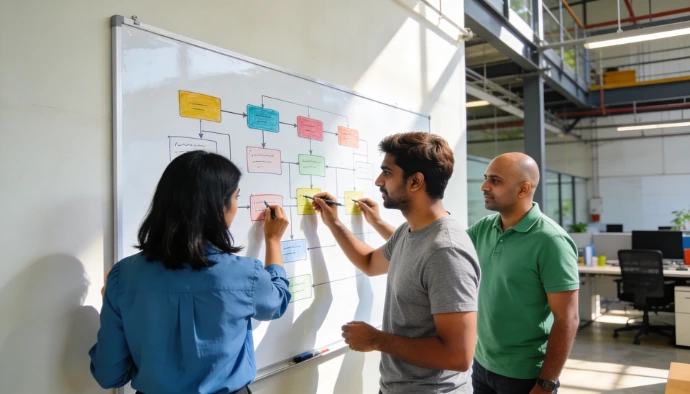
Our approach is simple: instead of proposing a monolith from the outset, we prefer to split the project into phases.
The client does not commit to "the whole project" on day one. They commit to a concrete first step: an initial scoping, a first scope (such as sales management for example), a first topic to tackle. Then we work together.
And once that first step is complete, the client can ask themselves a real question, far healthier than any theoretical comparison: "Do we want to keep working with them?"
For us, it is a much more honest proof of quality
This approach also works in our favor, precisely because it exposes us. If our work is vague, poorly scoped, too expensive for the value created, or painful for the client to live with... they have no reason to continue after the first phase.
Conversely, if the trade-offs are sound and the collaboration goes well, the client naturally stays.
Clients who started a first "phased" project with us have kept working alongside us for more than two years.
For us, this is probably the most meaningful proof. Not because it proves we are perfect, but because it shows that when companies start working with us, most of them choose to stay.
What an SME in Lyon really expects from an integrator
The honest answer is that you never choose a partner perfectly "on paper". Of course, you need to make sure they understand your business, that they are geographically close, and check their implementation method.
But you also have to accept that part of the quality stays invisible until you have rolled up your sleeves.
When an SME looks for an Odoo integrator in Lyon, it is not just looking for a technician to configure modules. It is looking for someone who helps it:
- Bring order back to its tools.
- Centralize information and cut down on double data entry.
- Track sales more closely.
- Make its data reliable.
- And above all, make sure that teams actually use the tool.
In other words, it is looking for a partner able to move the business forward without drowning it in an oversized project.
Conclusion
Finding the right integrator is not easy. And it is better to say so openly.
This is not a market where you can compare providers in a purely objective way. As with a mechanic, most of the value shows in the work itself. That is why we firmly believe in well-split first projects rather than blind commitments.
The client tries us out. They see how we work. And then they decide to stay… or not. In our view, it is the healthiest way to build a long-term relationship around a tool as critical as Odoo.
- How an ERP audit works: /comment-se-deroule-un-audit-odoo
- Standard vs custom: /comment-custom-odoo-quand-faut-il-eviter
- Our view of implementation: /comment-faire-une-implementation-odoo

Article written by Billy Felicie
Odoo integration expert at Hors du Commun (Lyon). I have been helping SMEs set up their digital tools and optimize their business processes for more than 5 years.